Short answer
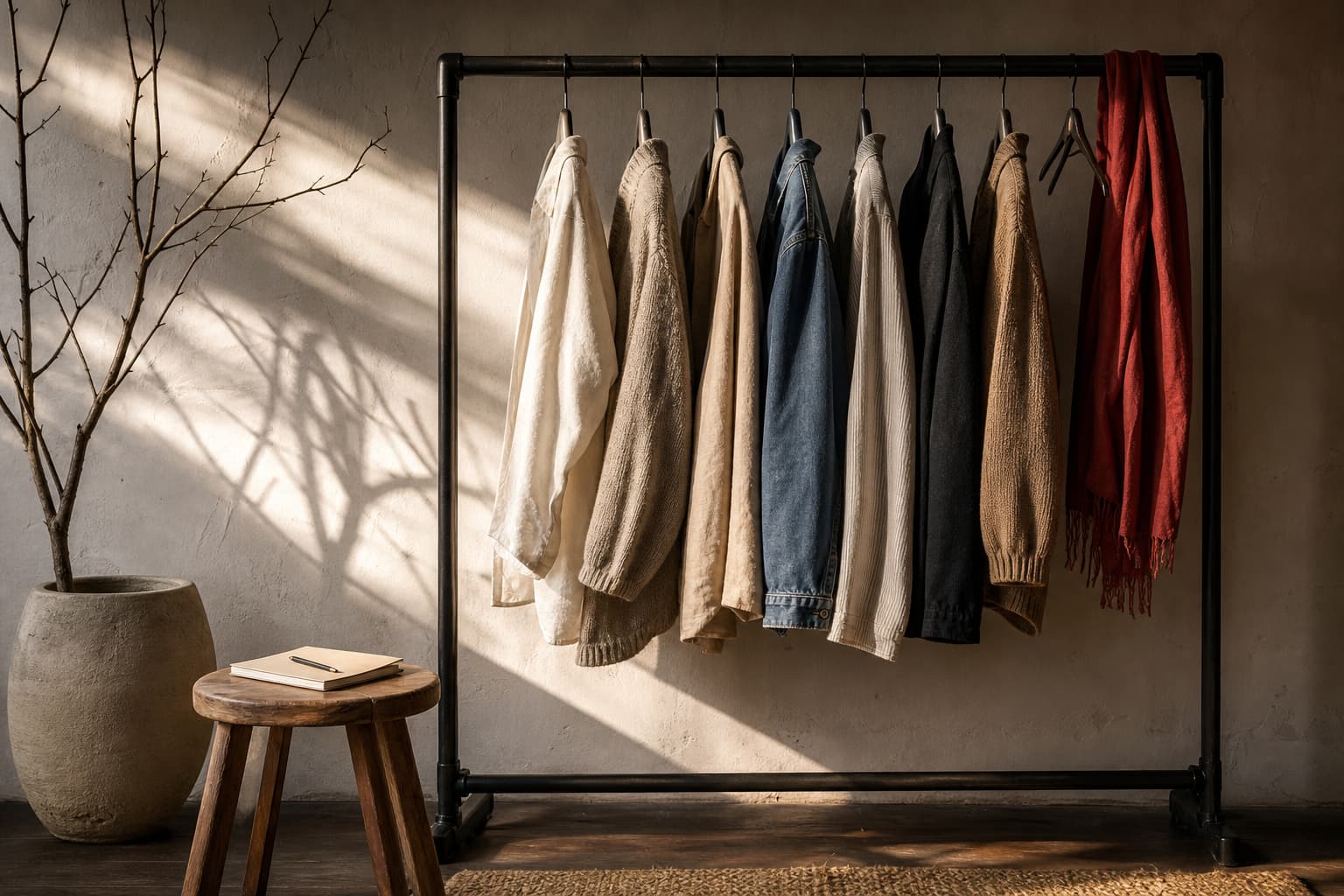
A capsule wardrobe is not a prescribed number of garments. It is a small working wardrobe that covers your real week, lets you get dressed easily, and does not require a stream of new purchases. Build it by testing what you already own for two weeks, recording repeated outfit problems, and buying only a specific replacement or a proven gap—not a vague idea of becoming more stylish.
What is a capsule wardrobe, and how many clothes should it include?
A capsule is a set of clothes for a defined stretch of life: perhaps the next six to eight weeks of workdays, errands, social plans, weather, and travel. The pieces work together, feel good to wear, and fit the life you actually have.
There is no evidence-based magic number such as 30, 33, or 50. A person who commutes to an office, exercises often, and lives with sharp seasonal changes needs a different system from someone who works at home and rarely needs formal clothes. A 2026 wardrobe study makes the useful point that perceived sufficiency is personal; it cannot be reduced to past wear alone [1]. The goal, then, is not to own as little as possible. It is to have enough for the coming weeks.
Use a practical test: your capsule is working if you can dress for most routine situations without emergency laundry, an unplanned purchase, or the sense that the clothes are someone else’s version of you. If it does not work, do not begin by ordering more. Identify the exact situation it fails to cover.
How do you build a capsule wardrobe from what you already own?
Give this one calm hour rather than an entire weekend. Do not begin by purging the closet. A dramatic clear-out can easily create a long list of urgent replacements. If clutter is the immediate problem, separate this project from decluttering and start with how to declutter your home step by step.
-
Describe the next six weeks in five lines. Note how many days usually involve working away from home, working at home, exercise, errands or social plans, and special dress codes. Add weather and transport. Replace a broad goal such as looking more polished with a usable one: I need clothes for three office days a week, including a walk from the train in rain.
-
Pull a first working set, not your whole closet. Take out clothes you have willingly worn in recent months: tops, bottoms, dresses or jumpsuits, layers, outerwear, shoes, and essential underlayers. Put occasionwear and out-of-season pieces aside for now. A capsule is not meant to contain every possession.
-
Check fit, comfort, and care now. Try on uncertain pieces. Sit down, raise your arms, walk in the shoes you would actually wear with them. Set aside garments that need repair, tailoring, or cleaning. Do not count a piece as functional because it was expensive, new, or theoretically useful someday.
-
Make 10 to 15 real outfits. Do not just picture them. Wear them, take quick mirror photos in ordinary light, and label each one in a note: office, rain; Saturday, 50°F; video call. On iPhone, use Notes with photos; on Android, Google Keep or any notes app will do. Create one note called Seasonal outfits instead of starting a new inspiration board every evening.
-
Give each garment a job. Mark it as an outfit anchor, layer, accent, or specialist item. Five near-identical accent tops will not solve the lack of a comfortable outfit anchor. Naming the jobs makes the imbalance visible.
-
Keep a little redundancy. A second dependable shirt, pair of shoes, or warm layer is not a minimalist failure. A modest backup reduces panic laundry and last-minute shopping.
One exploratory study followed ten women through a three-week capsule-wardrobe experience and reported less trend pressure and more conscious consumption. That is interesting, not a universal promise: the sample was small and narrow [2]. Treat a capsule as an experiment in your own life, not a guaranteed personality upgrade.
How can you tell a real wardrobe gap from an excuse to shop?
A real gap is observable: I have no rain-ready shoes for two weekly walking commutes, or my only work-appropriate pants have worn through. A shopping impulse usually has a looser story: this color is everywhere, this will finally make my style coherent, or the sale is too good to miss.
Before you buy, write a short buying brief. It is more protective than endless product comparison.
| Question | Evidence of a real gap | Evidence of an unnecessary purchase |
|---|---|---|
| What situation does it solve? | A specific, recurring situation | An imagined future lifestyle |
| What do I already own? | Nothing suitable, or the usable item is worn out | Similar pieces that were never tested in outfits |
| What will I wear it with? | At least three outfits you have already assembled | It needs new shoes, a bag, or another top to work |
| What leaves the system? | It replaces a named item or fills a documented gap | It simply joins a group of near-duplicates |
| What will I think in 30 days? | The need and budget are still clear | Urgency depends on a discount or limited stock |
If the line between want and need feels blurry, use the 30-day rule to stop impulse buying. For a seasonally urgent item, you can shorten the pause to seven days, but keep the outfit test and spending limit.
Try this no-purchase experiment for 14 days
This is the most reliable way to stop capsule building from becoming shopping with better branding.
- Choose 20 to 35 weather-appropriate items you already own. Buy nothing, including the supposedly perfect basic T-shirt.
- Put the rest of your everyday clothes out of sight for 14 days: a garment bag, high shelf, or box is enough. Do not discard or donate them.
- Each evening, record what you wore, whether it was comfortable, what you genuinely lacked, and what you ignored.
- When you want to buy something, add it to a waiting list with the date, price, job it must do, and three outfits from your photos.
- On day 15, look at the record rather than your aspirations. A purchase is eligible only if the same problem appeared at least twice and cannot be solved by repair, laundry, a different combination, or a stored backup.
You do not need a specialist wardrobe app. You need a trace of use. WRAP’s research on clothing longevity also emphasizes that how a garment is acquired and used affects its expected life [3]. The practical takeaway is simple: increase the use of suitable clothes you already own before hunting for a new supposedly perfect material or label.
What buying rules prevent a capsule from growing again?
Pick three to five rules that are firm but livable.
The three-outfit rule. A new piece must work with at least three clothes already in your wardrobe. Test this in photos or in the fitting room, not in your imagination.
The replacement rule. A purchase enters when it replaces a worn-out item or solves a recorded gap. You do not have to throw the old piece out at once; first decide whether it can be repaired, sold, passed on, or used until it is truly done.
The full-price rule. Count the price before the discount, plus shipping, alterations, care, and likely return friction. A sale does not turn a non-need into a need.
The cost-per-wear rule. Divide the full cost by a realistic number of wears. This is not permission to rationalize an expensive purchase: forecasts are easy to inflate. Still, six preregistered experiments found that cost-per-wear comparisons shifted choices away from cheap, lower-quality options when the higher-quality garment genuinely had a lower estimated cost per wear [4]. Estimate conservatively. Instead of claiming you will wear a coat 200 times, name 20 or 30 plausible occasions.
One open need at a time. If you are looking for rain boots, do not also buy the sweater, belt, and tote that an ad suggests. Solve one job, live with the solution for two weeks, then return to your list.
This matters especially online. Turn off retail push alerts, unsubscribe from promotional emails, and put products on a waiting list rather than in a cart. If marketing emails are a regular trigger, use our guide to unsubscribe from emails in Gmail in bulk.
Should you buy a whole set of high-quality basics from scratch?
Usually, no. Quality basics are often marketed as a reason to replace everything at once: shirts, jeans, coat, sneakers, and even storage accessories. That is still overbuying—just at a higher price point.
Buy gradually when an old item is worn out or when the 14-day test reveals a recurring, unfilled need. Check seams, fiber content, care instructions, repairability, and whether the item works with your everyday shoes. Care and continued use matter more than the fantasy of a fresh start. The U.S. Environmental Protection Agency reports that textiles made up 17 million tons of municipal solid-waste generation in 2018, while 11.3 million tons were landfilled [5]. Keeping fitting clothes in use longer and avoiding a duplicate bought for a brief mood is a direct, manageable response.
Secondhand, swapping, and renting can be useful for occasional needs, but they do not cancel the buying brief. A low price or a circular route does not make an unsuitable garment necessary.
When this does not apply
A strict, compact capsule may be unhelpful during body-size changes, pregnancy, recovery from illness, a move to a new climate, a new role with an unfamiliar dress code, or a period of unpredictable caregiving. You do not need a perfect system during a transition.
Build a temporary two-week set instead, keep a small reserve, and buy only for the next verified need. A capsule should reduce friction. It should not become another reason to judge your body, your budget, or your past purchases.
The point is a decision system, not a shopping list
A good capsule wardrobe gives you more useful repeats, not less personality. It is built from clothes you already enjoy, outfits you have tested, and clear limits: wear first, notice the gap, then buy one proven replacement. If you feel tempted to start over, begin with 14 days of observation—not an order confirmation.
Sources
- How much is enough? Operationalizing perceived clothing sufficiency through wardrobe studiesJournal of Cleaner Production / ScienceDirect
- Finding yourself in your wardrobe: An exploratory study of lived experiences with a capsule wardrobeClothing and Textiles Research Journal / SAGE
- Citizen Insights: Clothing Longevity and Circular Business Models Receptivity in the UKWRAP
- Shifting toward quality: how communicating cost per wear influences consumer preference for clothingPsychology & Marketing / University of Cambridge Repository
- Textiles: Material-Specific DataU.S. Environmental Protection Agency
Short answers
How many items should be in a capsule wardrobe?
There is no universal number. Start with enough clothes to cover two ordinary weeks, including weather, laundry, work, and rest, then adjust from what you actually use.
Should I sell or donate all my old clothes before building a capsule?
No. Live with a working set for 14 days first and keep the rest separate. Decide what to repair, sell, donate, or retain after you have evidence, not during a burst of motivation.
Can I buy secondhand for a capsule wardrobe?
Yes, if it passes the same test: it solves a defined job, works in at least three existing outfits, and fits well. A lower price should not remove the need to check it.
What if my clothes coordinate but my wardrobe feels boring?
First make new combinations with what you own and wear them for a week. If needed, add one or two expressive accessories or accent pieces rather than replacing your whole color palette.