Short answer
A no-buy list is a short, temporary list of things or categories you will not buy because you already have enough, rarely use what you buy, or tend to spend there on autopilot. It works best when it also says what is allowed, what counts as a replacement, and what exceptions are reasonable. Try it for 14 days first: the point is to learn what prompts your purchases, not to prove that you can deny yourself everything.
No-buy and low-buy conversations are again visible in personal-finance and minimalism spaces. Recent r/nobuy threads are not evidence of what most people do, but they are useful discovery signals: contributors repeatedly describe clearer rules, replacement criteria, and planned exceptions as more workable than banning all spending [6]. Guidance from a university sustainability office and the CFPB points in the same practical direction: define boundaries before you are in front of a tempting purchase [1][2].
What is a no-buy list, exactly?
A shopping list answers, “What do I need to get?” A no-buy list answers, “Which decisions am I not going to reopen every time an ad, sale, or bad day appears?” It might include:
- skincare until you finish an item already open;
- mugs, water bottles, or candles;
- stationery while usable supplies are at home;
- clothes bought for a hypothetical future self;
- sale items that were not in a plan;
- apps, courses, and subscriptions bought because you fear missing out.
This is not a moral verdict on buying. A new sweater, novel, or face cream is not inherently frivolous. The question is more modest: does the next one solve a problem that your current things do not solve?
It is also not a household constitution. One person may be trying not to buy takeaway coffee; another may be trying not to accumulate hobby supplies. Borrowing someone else’s strict rule can create resentment without changing the pattern that matters to you.
And a no-buy list is not a budget. A budget helps you see what money is available for necessities, goals, and enjoyment. A no-buy list reduces repeat decisions in one or two high-friction categories. If you do not yet have a basic view of your money, start with a simple three-number budget. The list will then have somewhere sensible to fit.
How do I choose what to put on a no-buy list?
Start with evidence from your own life, not with the internet’s most dramatic challenge. Look at roughly 30 to 60 days of card transactions, order history, or receipts. You are not building a case against yourself; you are looking for categories where purchases repeatedly fail to do the job you hoped they would.
Circle items for which two or more of these are true:
- You already own a usable version.
- You wanted it after an ad, a short video, a marketing email, or someone else’s recommendation.
- You buy it “for later” but rarely use it.
- The purchase brings doubt rather than relief.
- It creates storage, maintenance, or use-up pressure.
Choose one to three categories. A 20-item ban may feel decisive, but it leaves you doing too much interpretation in real life. Johns Hopkins’ practical no-buy/low-buy guide suggests identifying essentials, setting a few absolute-no categories, and defining criteria for non-essential purchases [1]. That is not a clinical protocol. It is simply a useful design principle: a rule should be easy to recognize and apply.
| What you notice | Add this to the list | A testable boundary |
|---|---|---|
| You keep finding duplicates | A specific item type | “No candles until I use two I already own.” |
| Sales create urgency | A purchase method | “I do not check out on the day I first see a sale.” |
| Small treats add up | A channel or time | “No in-app purchases after 10 p.m.” |
| A hobby outgrows the practice | Supplies or tools | “I complete three sessions with what I own first.” |
| Need is hard to assess | A broad category | “Clothes are replacement-only this month.” |
Keep the wording concrete. “Do not spend money on myself” is not a boundary; it is a vague source of guilt. “No new hair products until two open products are finished” tells you what to do at the point of purchase.
How do I make rules that allow for real life?
Every boundary has grey areas. If you do not name them in advance, you will have to negotiate them when you are tired, rushed, or looking at a countdown timer. For each no-buy category, add three notes.
- What is allowed? Food, health needs, basic household supplies, planned gifts, transportation, and a necessary replacement may all sit outside the experiment.
- What counts as a replacement? “I like the newer version better” is not the same as a loss of function. Define replacement as used up, unsafe, irreparable, or unable to perform a needed job.
- What pause is required for an exception? For example, write down the item, price, and reason; revisit it after 48 hours. Use a longer pause for a more expensive purchase.
This will not make every purchase wise. It does move the decision away from the hottest moment. The CFPB’s consumer guidance advises noting the product, where you found it, and its price, then checking it against your spending plan before going back to buy it [2]. That is a useful response to artificial urgency, especially during sales-heavy periods.
There is also a modest research reason to make rules specific. Studies of implementation intentions examine plans in an “if X, then I will do Y” form. Most of that evidence comes from contexts other than shopping, so it would be misleading to claim that one sentence cures impulse spending. Still, the underlying idea is practical: link a familiar trigger to a small action before you need it [3][4].
Try rules like these:
- “If an ad makes me want something on my list, I write down why it seems useful instead of saving the product link.”
- “If I want skincare, I photograph the open products in my bathroom first.”
- “If an item is above my set amount, I explain the purchase on paper tomorrow.”
- “If I want an organizer, I clear and measure the space before I shop.”
That last rule matters at home. A container can be genuinely useful, but it can also make excess look tidier without reducing it. Before buying storage, see whether there is less to store; this step-by-step decluttering plan can help you start there.
How can I try a no-buy list for 14 days?
Do not buy a special planner, tracker, or “no-buy kit.” A note on paper, a calendar, or a plain phone note is enough.
- Pick a start date and one learning goal. Not “be better with money,” but “find out why I order skincare when I am exhausted” or “stop adding clothes before I wear what I own.”
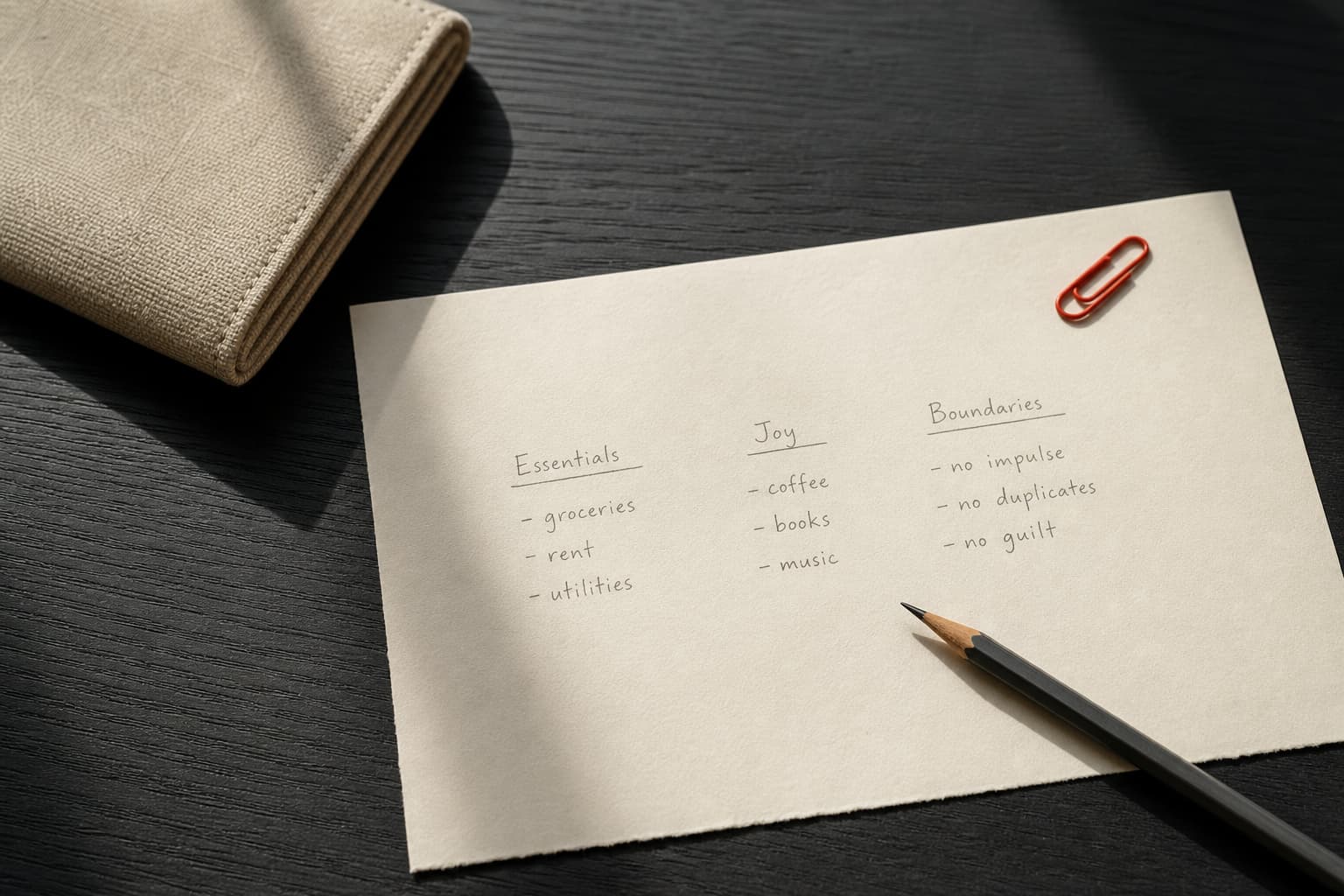
- Make three columns: allowed, not buying, exceptions. Put them where you usually shop.
- Remove one cue for two weeks. Unsubscribe from one retailer, remove saved payment details from one store, or turn off its push notifications. If emails are a steady route to your cart, use this guide to bulk-unsubscribing in Gmail.
- Record urges, not just purchases. One line is enough: date, item, where you saw it, what happened just before, and whether you bought it. This is observation, not a scorecard.
- For an allowed purchase, write the reason. “Laundry detergent ran out” is useful data. So is “I was upset and delivery was available in 15 minutes.” They simply point to different needs.
- Review on day 14. Drop a rule that never mattered. Tighten a rule that produced repeated confusion. Soften a rule that made normal life needlessly difficult.
A no-purchase experiment: the cart without checkout
For 14 days, do not forbid yourself from browsing. When you want something from your no-buy category, add it to a cart or a plain note but do not pay. Beside it, answer three questions: “What job would this do?”, “What already does that job?”, and “What changes if I return in 48 hours?”
At the end, do not congratulate yourself for “winning” or punish yourself for wanting things. Look for information. Which wants faded? Which came back? Which were genuine replacements? A repeated want is not an automatic instruction to buy. It is a signal to describe the need and your buying criteria more clearly. If the item is genuinely useful and affordable, buying it deliberately is better than turning a no-buy list into a deprivation contest.
What if I break my own rule?
One purchase does not erase the experiment. It tells you that the rule was too broad, the cue was stronger than expected, or the purchase was covering a real need you did not account for.
Instead of saying, “I ruined it,” write down:
- what you bought;
- which rule applied;
- what happened immediately before;
- whether the item was needed but missing from the exceptions;
- one change that could make the next decision easier.
Say you buy a notebook despite a stationery ban. You may need a clearer rule: “No paper notebooks until I fill one of my two active ones; quick ideas go in my phone notes.” Or you may discover that paper is genuinely necessary for a particular kind of work. The goal is an honest boundary, not severity for its own sake.
If buying is regularly your way to cope with intense anxiety, loneliness, debt stress, or a feeling of lost control, a list may be too small a tool on its own. Consider adding a conversation with someone you trust, a nonprofit financial counsellor where available, or mental-health support. That is not a failure of minimalism; it is choosing support that matches the size of the problem.
When this doesn’t apply
A no-buy list is not a good project during instability: when you cannot reliably meet basic needs, are moving, are caring for someone who is ill, or urgently need to set up a safe home. It is also not a substitute for debt help or a full review of essential bills when spending has become unmanageable.
You do not need one when a category causes no financial, physical, or emotional friction. Minimalism is not about manufacturing restrictions around purchases that are rare, useful, and comfortably affordable.
FAQ
What is the difference between a no-buy list and a no-buy month?
A no-buy month often limits most discretionary spending for a set period. A no-buy list is narrower: it blocks particular categories and can be part of a gentler low-buy approach.
What should I put on a no-buy list first?
Start where you already have a backlog, repeatedly buy duplicates, or feel regret afterward. Common examples include clothes, beauty products, décor, stationery, hobby supplies, and sale purchases.
Can I buy gifts during a no-buy experiment?
Yes. Put planned gifts in the allowed column and give them a budget or a clear limit. Leaving gifts as a grey area makes it easier for “while I’m here” spending to grow.
What if something on my no-buy list breaks?
Use your replacement rule: check whether it can be repaired, whether something at home can do the job, and whether the function is necessary. A needed replacement is an exception, not a failed experiment.
How long should a no-buy list last?
Begin with 14 days or one month. Keep only the boundaries that reduce unwanted decisions without making daily life harder.
Sources
- Ask the Green Guide: “No-Buy” or “Low-Buy” ChallengeJohns Hopkins University Climate & Sustainability
- Plan your spending to avoid holiday debtConsumer Financial Protection Bureau
- Implementation intentions and efficient action initiationPubMed / Journal of Personality and Social Psychology
- An experimental investigation of breaking learnt habits with verbal implementation intentionsPubMed / Journal of Experimental Psychology: General
- More people make ‘no-buy year’ pledges as overspending or climate worries catch up with themAssociated Press
- No Buy November — What Are Your Rules?Reddit, r/nobuy
Short answers
What is the difference between a no-buy list and a no-buy month?
A no-buy month often limits most discretionary spending for a set period. A no-buy list is narrower: it blocks particular categories and can be part of a gentler low-buy approach.
What should I put on a no-buy list first?
Start where you already have a backlog, repeatedly buy duplicates, or feel regret afterward. Common examples are clothes, beauty products, décor, stationery, hobby supplies, and sale purchases.
Can I buy gifts during a no-buy experiment?
Yes. Put planned gifts in the allowed column and give them a budget or another clear limit. Do not leave them as a grey area.
What if something on my no-buy list breaks?
Check whether it can be repaired, whether something you own can do the job, and whether the function is necessary. A needed replacement is an exception, not a failure.
How long should a no-buy list last?
Begin with 14 days or one month, then retain only boundaries that reduce unwanted decisions without making daily life harder.