Short answer
When family members disagree about decluttering, do not declutter their possessions or try to win an argument about how much is “enough.” Start with your own things, then make shared areas more usable by agreeing on one practical outcome: a clear dining table, a safe hallway, or an easier morning routine. The useful unit of change is a small, reversible agreement with clear decision rights—not a whole-house purge.
Evidence on clutter is worth taking seriously, but modestly. Research has found associations between seeing one’s home as stressful or unfinished and mood-related outcomes; it does not show that a dramatic cleanout will fix a relationship or a mental-health problem. (pubmed.ncbi.nlm.nih.gov) The best goal is less daily friction, not a home that looks minimal on social media.
Why does decluttering become a family argument?
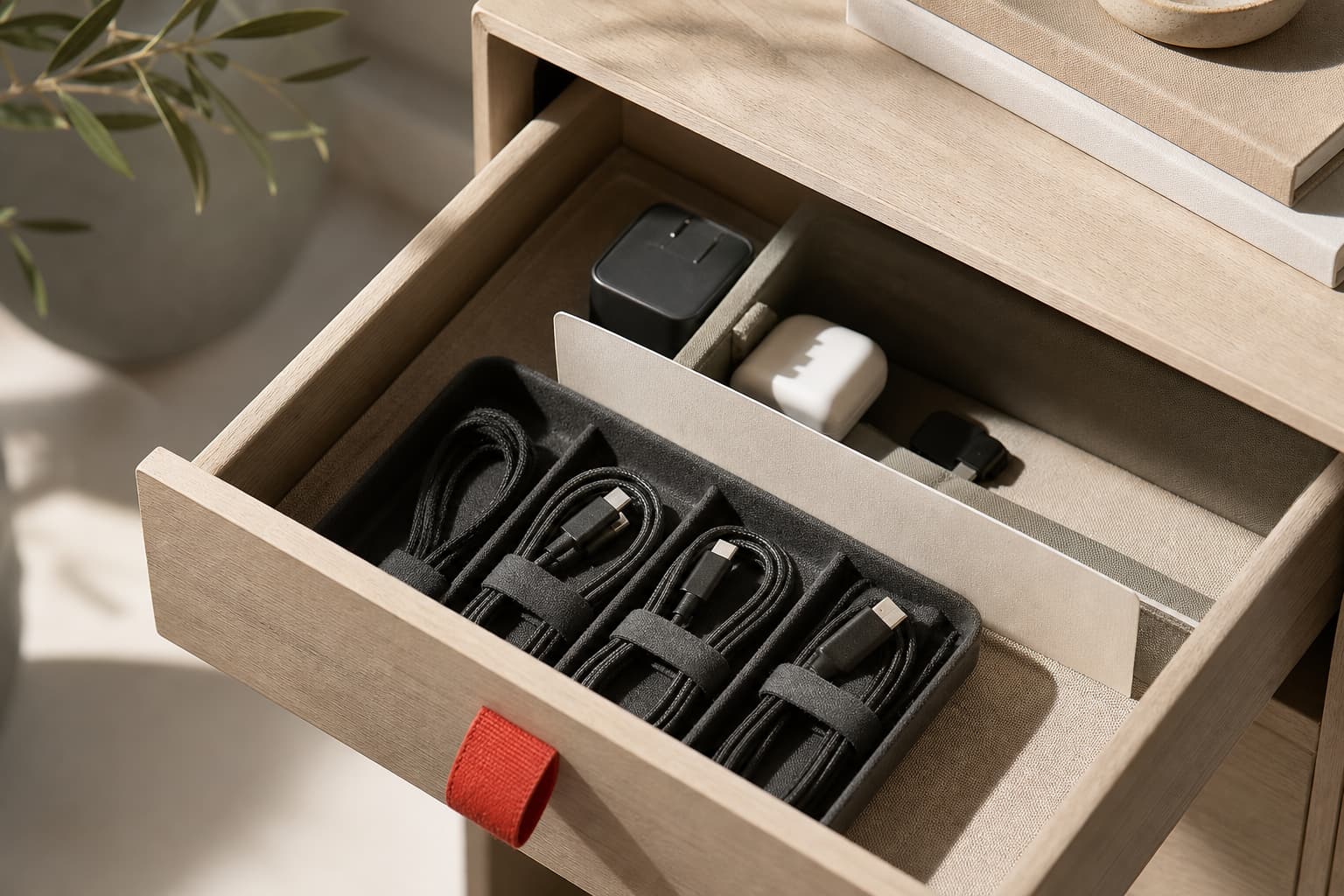
Decluttering alone is mostly a personal decision. In a household, every object may also carry ownership, memory, backup value, identity, or a promise of future usefulness. Your partner’s stack of old cables may look like visual noise to you and like sensible preparedness to them. A child’s papers may look disposable to an adult and feel like evidence that their work matters.
That is why the argument is rarely about the mug, the jacket, or the box. It is usually about:
- Autonomy: Who gets to decide what I keep?
- Fairness: Why are my things called clutter while yours are called useful?
- Household burden: Who searches, cleans around, stores, and pays for all this?
Relationship research offers a useful distinction here. Directly addressing a serious, changeable problem can help more than hints or passive resistance, but it works best when the request is also cooperative and specific. (pubmed.ncbi.nlm.nih.gov) So name the blocked hallway; do not diagnose your partner as “a hoarder” because they own more than you do.
Try this shift:
- Not: “This house has too much stuff.”
- Instead: “We cannot sit down for dinner because the table is full.”
- Not: “You save everything.”
- Instead: “I need this path to stay clear so we can get through safely.”
The second version describes a shared problem and a use for the space. It does not turn the owner into the problem.
Can you declutter your partner’s, parent’s, or child’s belongings?
As a rule, no—not without clear permission. Do not hide items to “see whether they notice,” donate bags while they are out, or throw things away during an argument. The object may be cheap and unused, but taking the decision away can cost far more in trust.
There is a narrow safety exception. You may need to clear an exit, remove spoiled food, secure dangerous chemicals from a child, or reduce an immediate trip hazard. Keep the intervention as limited as possible, explain the risk plainly, and tell the owner where items were moved. “Safety” should not be a shortcut around someone’s refusal when the real issue is visual preference.
For children, keep the same respect for ownership while setting age-appropriate limits on space and safety. A child can choose which toys or drawings remain within a defined shelf, bin, or display area. Adults set the container; children should have a voice in what goes inside it. If the recurring conflict is screens rather than physical belongings, use a separate agreement rather than an all-purpose ban: How to Manage Kids’ Screen Time Without Constant Bans.
How do you make shared-space decluttering fair?
Start by sorting decisions, not objects. A shared home contains different types of territory.
| Area or item type | Who decides | Useful default rule | Example |
|---|---|---|---|
| Personal belongings | The owner | Do not touch without consent | Clothes, hobbies, papers |
| Shared belongings | Regular users | Discuss the use and storage limit | Cookware, tools, first-aid supplies |
| Shared surfaces | People who use the surface | Give it one primary function | Dining table, entry console, sofa |
| Children’s belongings | Child plus caregiver | Adult sets safe capacity; child chooses | Toys, art, school papers |
| Hazardous items | Responsible adult; specialist if needed | Address risk before aesthetics | Expired medicines, unsafe chemicals |
Then have a 15- to 20-minute conversation away from the mess itself. Do not begin when someone has just come home tired or is already cleaning in anger.
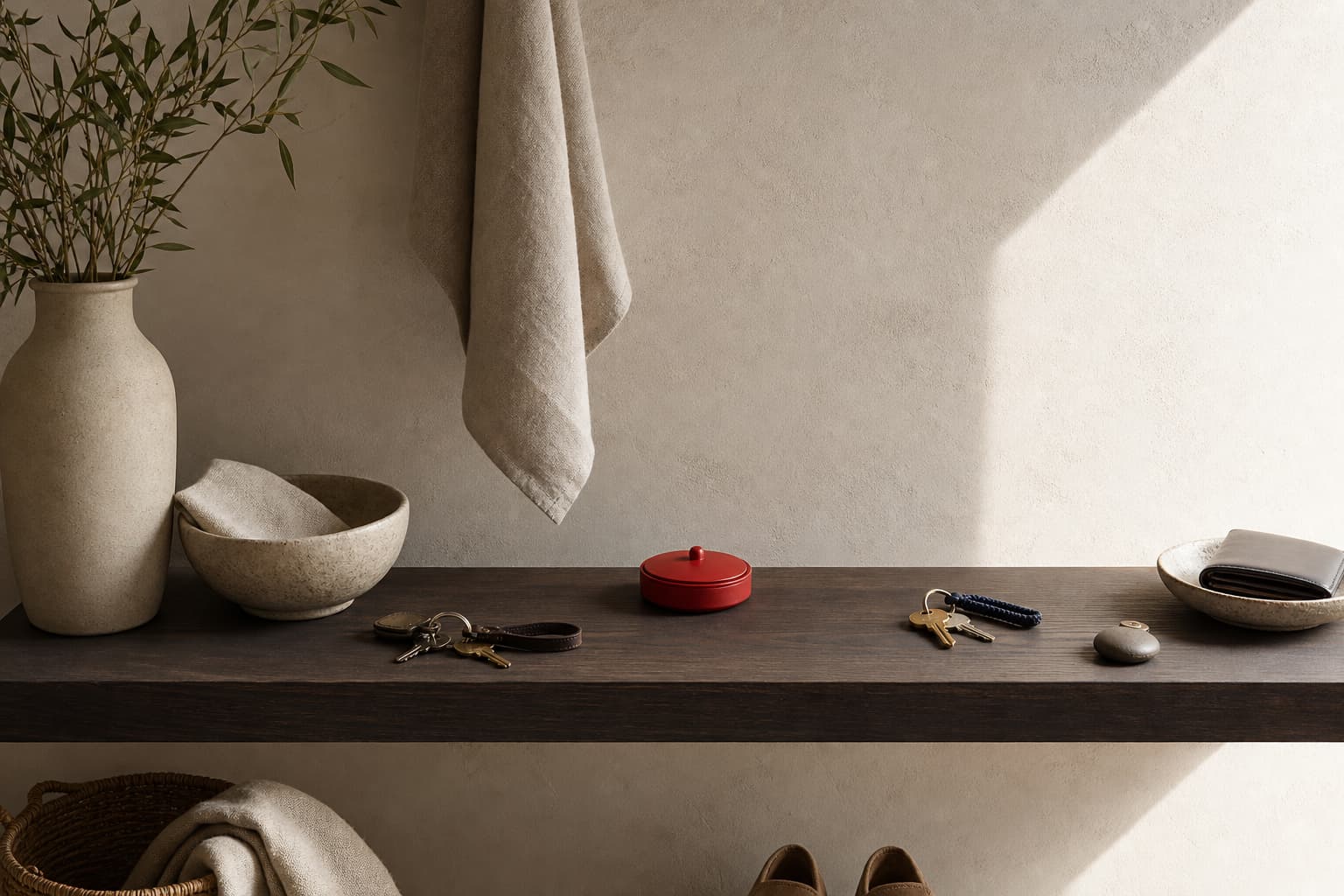
- Name one observable cost. “I spend ten minutes looking for keys every morning.” Avoid a case against the other person’s personality.
- Ask what the things are doing for them. “What needs to stay within reach? What feels important to keep?” The answer may be a genuine backup need, a project, a memory, or anxiety about money.
- Choose one small zone. Pick the entry shelf, one bathroom drawer, or half the dining table—not “the entire house.”
- Agree on a visible capacity. One tray, shelf, basket, or drawer. A capacity limit is information, not punishment: once it is full, a new decision is needed.
- Set a review date. After 7–14 days, ask whether the zone is easier to use and what is not working. Revising the rule is not failure.
A calm request sounds like this: “Could we try keeping this surface clear for breakfast for two weeks, with everything else going into this one tray? Then we can decide together whether it helps.”
What if a family member says, “I need all of this”?
Do not litigate the value of every cable, vase, or duplicate pan. You probably use different standards, and item-by-item debate can continue forever. Move from “Should this exist?” to “How can this exist without taking over a shared function?”
Ask four practical questions:
- Where can this live without blocking the room’s agreed use?
- Who will maintain it and put it back after use?
- What would tell us that the backup amount has become too large?
- What happens when its designated space is full?
This is not an ultimatum to discard. It is an invitation to keep an item without making everyone else responsible for its storage. Tools can stay, for example, but their home may be one closing drawer rather than the hallway floor. Sentimental cards can stay, but in one labeled archive box rather than on the dining table.
Sometimes “I need it” means “I am afraid we will have to buy it again.” That is partly a money conversation. Instead of demanding that someone get rid of backups, look at what you actually repurchased in the past year, what can be borrowed, and what quantity is enough. For future purchases, a pause and a clear use case can reduce the stream of incoming things; see How to Stop Spending Money on Things You Don’t Need.
A no-buy experiment: keep one table clear for 14 days
Do not begin by buying bins, labels, or a new storage system. First test whether a new rule solves a real problem.
The experiment: choose one shared surface—often the dining table—and agree that for 14 days it is only for meals, schoolwork, or a planned shared activity.
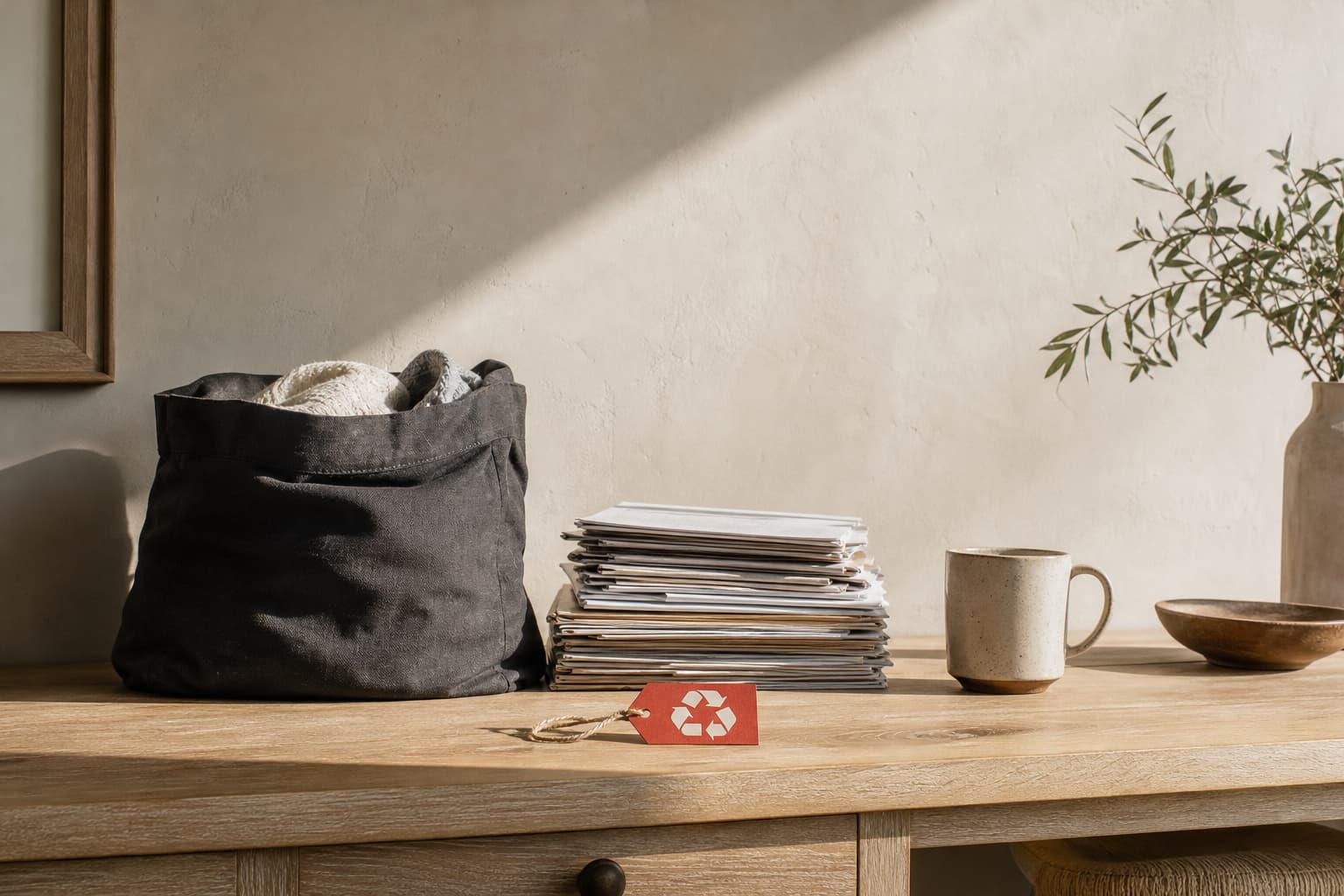
- Move everything currently on it into one box, bag, or basket you already own. Do not discard anything.
- Keep that container nearby rather than hiding it in a closet. The point is to reveal the flow of objects, not conceal it.
- When a non-table item lands there, place it in the container without commentary.
- At the end of week one, sort only the container together: return, assign a permanent home, defer, or move to the owner’s area.
- On day 14, answer three questions: Did we use the table more? Did mornings or meals feel easier? Is one container enough?
This is useful because nobody loses an item. The family is testing a practical hypothesis—does a clear surface improve everyday life?—rather than voting on minimalism. If it does not help, end or revise the experiment. If it helps, repeat the same method in only one other small shared area.
How do you prevent a “decide later” box from becoming permanent storage?
Deferral is reasonable when a decision is emotional or genuinely uncertain. It only becomes a problem when there is no owner, date, or next action.
Attach a plain note: owner / review date / next step. For example: “Sam / November 12 / choose ten cards for the memory album.” This works well for seasonal gear, paused hobbies, paperwork, and sentimental items.
Do not turn a date into a threat: “If you do not deal with this in a month, I will donate it.” Instead agree on the default outcome. The box might stay in the owner’s personal area, move to a more accessible place for a scheduled decision, or trigger a conversation about whether the capacity limit is realistic. If you want a method for your own belongings, start with How to Declutter Your Home: a Step-by-Step Plan, but do not apply it to someone else’s things unless they invite you in.
What should happen to items you do let go?
First separate usable goods from waste. Working electronics, clothing, books, and household items may be sold, passed to friends, donated, or reused. The U.S. Environmental Protection Agency recommends extending the life of functioning goods through reuse and notes that household chemicals and other hazardous materials need appropriate disposal rather than a casual donation box. (epa.gov)
Do not use donation as a way to pass unusable items to another organization. Check what a local group actually accepts, in what condition, and when. If you are giving to a charity or arranging a pickup, the Federal Trade Commission advises researching the organization before donating rather than acting under pressure. (consumer.ftc.gov)
A simple exit plan is enough: one bag for a named recipient, one box for a specific resale listing, and one small pile for local recycling or hazardous-waste guidance. Avoid creating five vague “donation someday” bags in the garage.
When this doesn’t apply
This household method is not a substitute for professional help when accumulation makes rooms unusable, creates fire, fall, or sanitation risks, or when attempts to part with possessions cause intense distress. The American Psychiatric Association describes hoarding disorder as persistent difficulty discarding possessions that leads to clutter substantially compromising the use of living areas. A forced purge can intensify conflict and does not address the underlying problem. (psychiatry.org)
Pause and seek outside support, too, if arguments about possessions involve threats, coercive control, financial abuse, or fear. Minimalism is never more important than safety, stability, and the right to feel secure at home.
The point
Minimalism with family is not a shared personality test, and it is not permission for the most organized person to rule the house. Protect personal ownership, discuss shared inconvenience directly, limit space rather than people’s worth, and prefer reversible experiments. A home feels lighter not when it contains the fewest possible things, but when everyone has a voice and shared rooms can do their job.
Sources
- No place like home: home tours correlate with daily patterns of mood and cortisolPubMed / Personality and Social Psychology Bulletin
- What Type of Communication during Conflict is Beneficial for Intimate Relationships?PubMed / Current Opinion in Psychology
- The relationship between household chaos and child, parent, and family outcomes: a systematic scoping reviewPubMed Central
- What You Can DoU.S. Environmental Protection Agency
- Before Giving to a CharityFederal Trade Commission
- What is Hoarding Disorder?American Psychiatric Association
Short answers
How do I declutter if my spouse refuses to throw anything away?
Do not touch your spouse’s personal belongings. Identify one shared problem, such as a blocked table or hallway, and propose a short, reversible trial with a clear storage boundary.
Is it okay to throw away my child’s things?
Adults set safety and space limits, but children should participate in choices about their possessions. Do not secretly discard meaningful items unless there is an immediate safety issue.
What counts as a shared item?
Treat an item as shared when multiple people use it regularly or it occupies a common functional area. When ownership is unclear, assume it is personal until the household agrees otherwise.
What can I do with items that feel too valuable to discard?
Do not force an immediate disposal decision. Give them a defined amount of space and a review date, then choose a specific next step: keep, sell, give to a named person, donate, or recycle appropriately.