Short answer
To stop scrolling before bed, do not make a nightly promise to have more self-control. Give your phone a regular charging place outside the bedroom, preserve a narrow channel for genuinely urgent contact, and prepare one low-effort alternative for the final 15 to 30 minutes of the day. This is not a ban on phones or a guarantee of perfect sleep. It is a way to make scrolling in bed less automatic when you are too tired to negotiate with yourself.
Research links technology use near bedtime and in bed with poorer sleep outcomes, but the relationship is not a simple one-way cause: people may also reach for a phone because they are already awake. So treat this as a practical experiment. The first useful result is not a perfect sleep score; it is less time spent accidentally turning bedtime into feed time.
Why is it so hard to stop scrolling in bed?
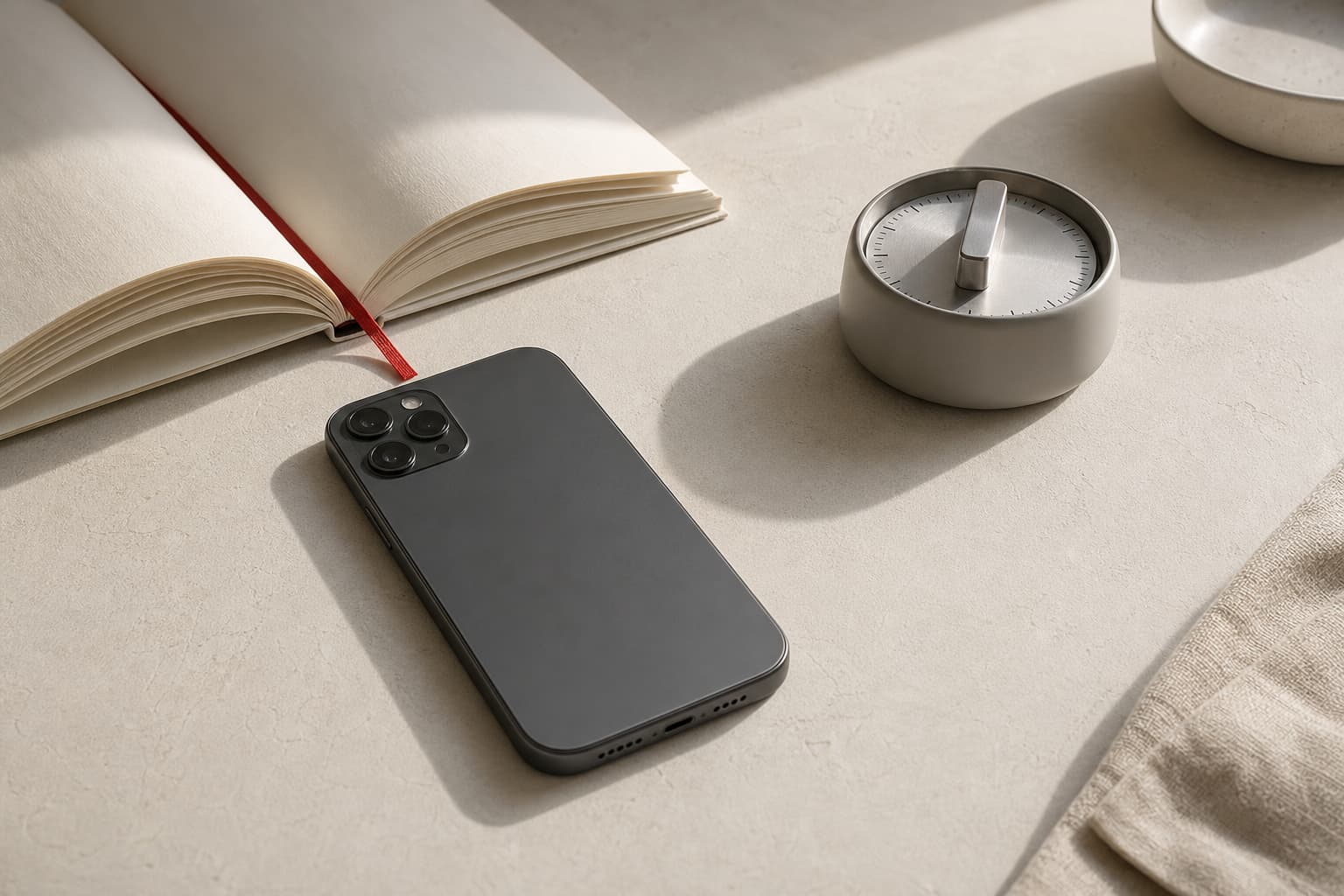
The phone is not merely a distraction. It may be your alarm, your connection to family, your music player, your book, your news source, your camera, and the only private corner of an overfull day. Put all of that on a nightstand and the gap between “I’ll just check something” and a long scroll becomes almost nonexistent.
Recent Reddit conversations describe this especially clearly. People say that grayscale, app timers, and Do Not Disturb may reduce some friction, but they do not solve the central problem when the device is still an arm’s length away. That is anecdotal evidence, not a representative finding. It is still useful as a design clue: an exhausted person is unlikely to make a careful decision repeatedly at 12:15 a.m.
The broader habit is common. In an American Academy of Sleep Medicine survey of 2,007 U.S. adults, half said they use a screen in bed every day. A 2026 study of adults found that 89.9% used electronic devices in the hour before bed and 76.5% used technology in the bedroom. Both findings describe behavior and associations; they do not prove that any one screen habit causes a specific sleep problem.
Still, location matters. A small study that combined app-use logs with wearable sleep data found worse sleep metrics associated with smartphone use in bed, while the authors also stressed the limits of their small sample and the uncertainty around cause and effect. The practical takeaway is modest: if you want to change a bedtime habit, change the place in which it happens before you start optimizing settings.
The National Heart, Lung, and Blood Institute notes that a TV, phone, or computer in the bedroom can distract from needed sleep. In minimalist terms, the goal is not a technology-free identity. It is to let the bed be mostly for sleep and rest again, rather than a place where every unfinished part of the day can re-enter.
Is it better to move your phone, block apps, or use Sleep Focus?
| Option | What it changes | Best use case | Its limit |
|---|---|---|---|
| Charge the phone outside the bedroom | Removes instant access in bed | You open apps automatically | You need an alarm and urgent-contact plan |
| Sleep Focus or Do Not Disturb | Reduces calls, banners, and vibrations | Notifications pull you in | It does not prevent intentional scrolling |
| App limits | Adds a pause before an app opens | You are willing not to override it | A tired person can dismiss the limit |
| Grayscale | Makes feeds less visually rewarding | Color and video are part of the pull | You can get used to it |
| A paper activity or quiet audio | Gives the evening another landing place | You need decompression after work | It must be ready before you are tired |
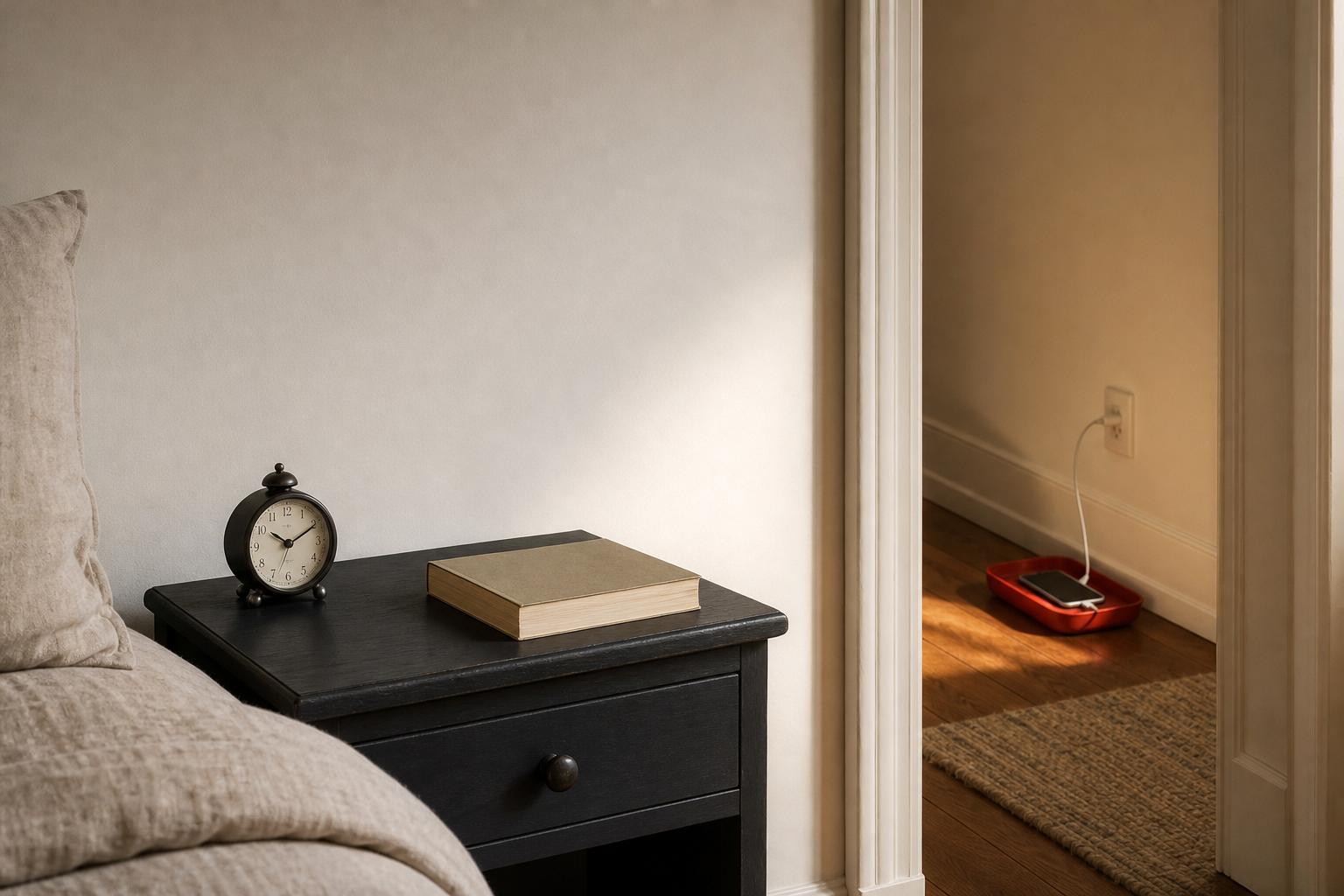
Start with the physical option because it costs nothing and requires the fewest decisions after lights out. Put the charger in a fixed place outside the bedroom. A hallway shelf, kitchen counter, or desk is enough. You do not need a locking box, a branded “phone bed,” or a new productivity system.
Keep software tools as backup rather than treating them as the whole solution. Sleep Focus can silence nonessential notifications, dim the screen, and allow selected people through. That can lower interruption without making you unreachable. But a setting cannot remove the invitation of an infinite feed that is already beside your pillow.
This follows the same principle behind giving your phone three levels of urgency: do not turn off everything indiscriminately. Decide what truly needs to reach you at night, then let the rest wait.
How to stop scrolling before bed: a seven-night plan
1. Give the phone a nightly parking place
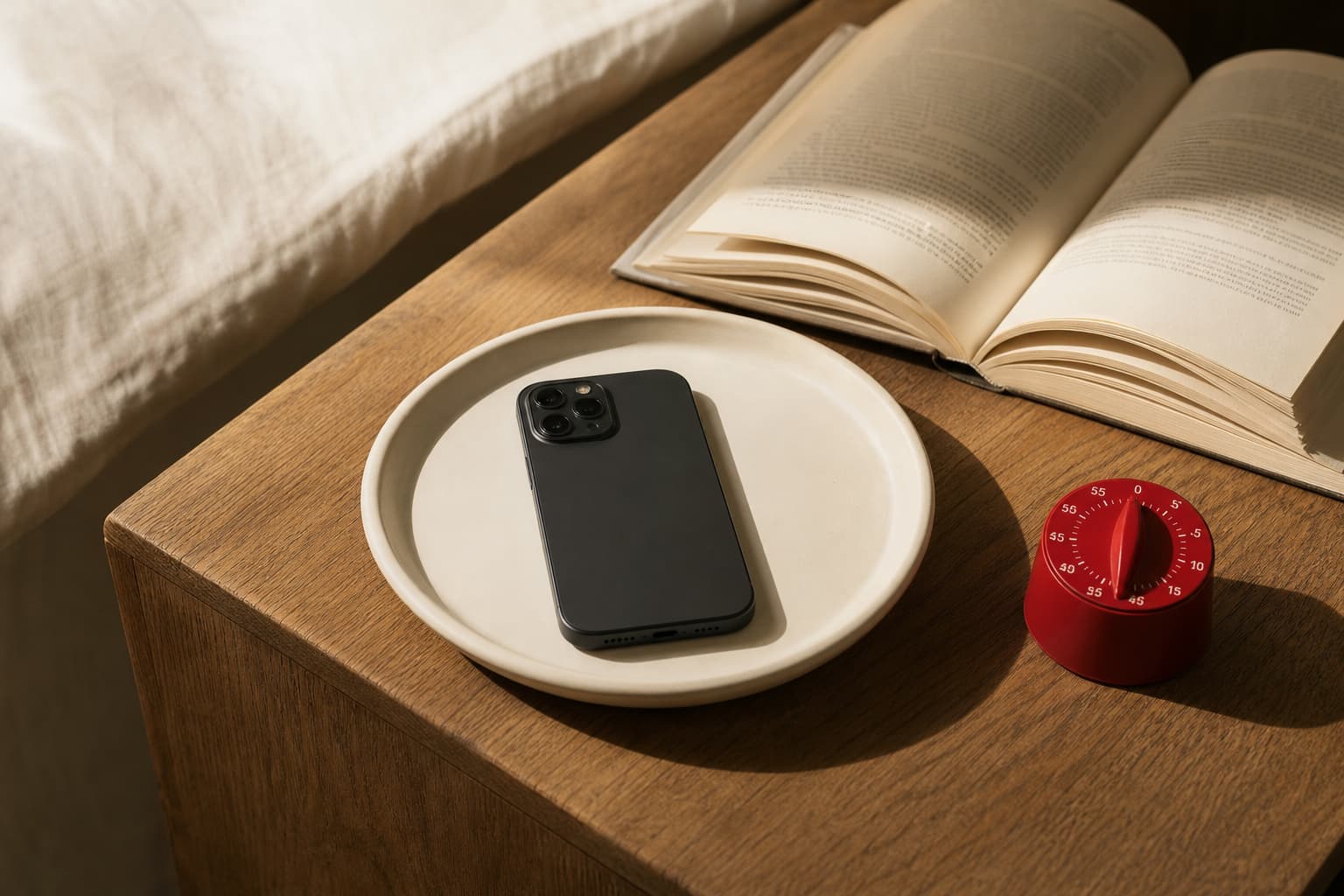
Pick one location outside the bedroom and use it every night for a week. Put the charger there. If the spot is cluttered, use a bowl, tray, or small clear patch of counter so the phone has an obvious home.
Make the rule concrete: “After I brush my teeth, my phone charges on the hall shelf.” Avoid vague rules such as “I’ll use my phone less.” A fixed action attached to a fixed place is easier to repeat than a decision you must remake at the end of every day.
2. Keep an emergency route, not every route
Many people keep the phone close because being unreachable feels irresponsible. Sometimes it would be. If you are on call, caring for someone, awaiting important news, or responsible for a child, do not build a system that ignores reality.
Instead, use Sleep Focus or Do Not Disturb deliberately. Allow calls from essential contacts and, if appropriate, repeated calls. Turn off the notifications that are merely urgent-looking: promotions, social badges, news alerts, group-chat noise. The point is not silence as a virtue. It is a narrower definition of what counts as urgent after bedtime.
3. Move your personal time earlier, rather than deleting it
For many people, bedtime scrolling is less about wanting one more video and more about wanting time that belongs to no one else. Removing that time entirely can make the rule feel punitive. Move it instead.
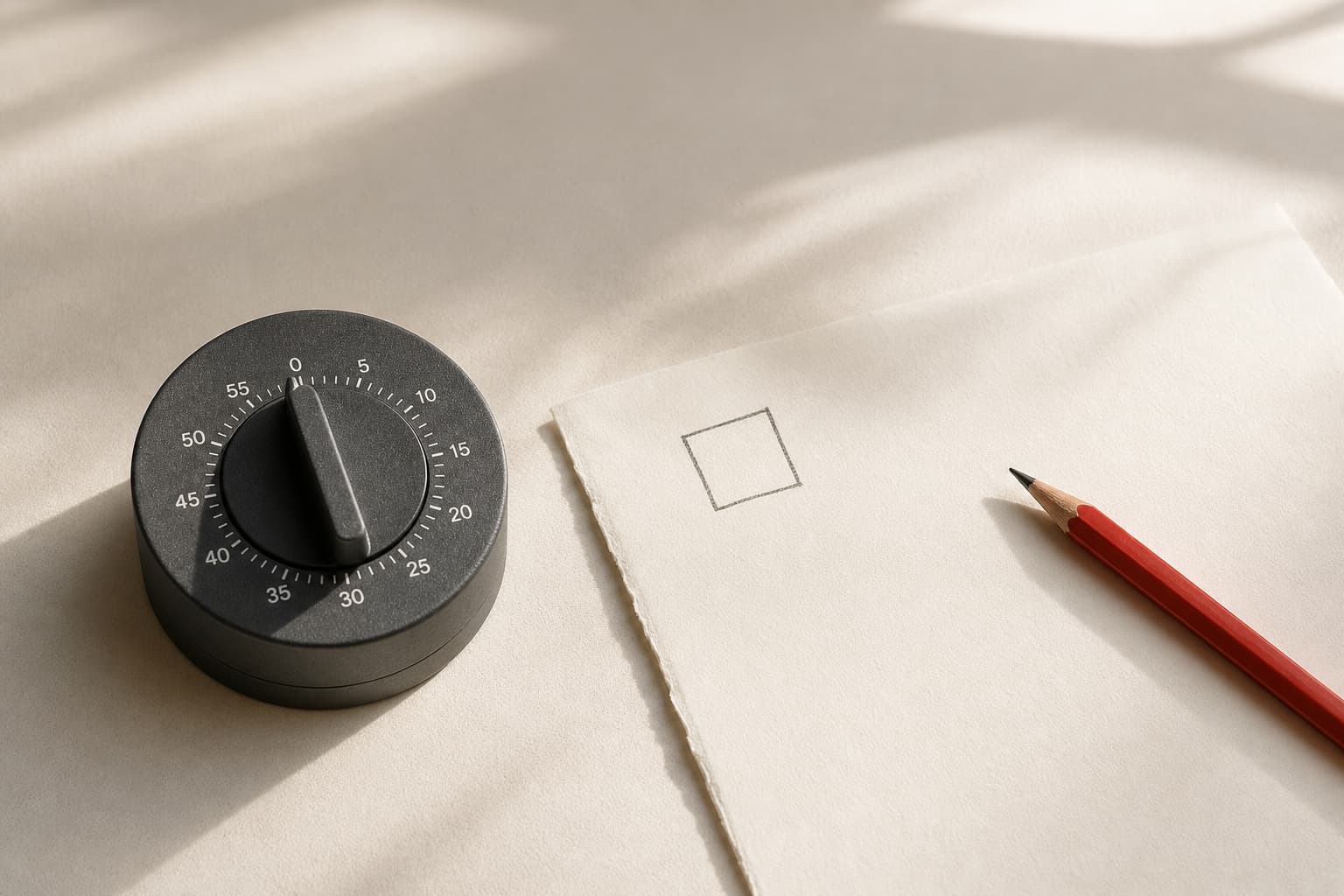
Give yourself a deliberate 15- or 20-minute scroll window before the bedtime routine starts, somewhere other than bed. Sit on the couch or at a table. Start a timer when you begin. When it ends, you do not have to become instantly serene or productive; you only move to the next small action: wash up, make tea, set out clothes, or read a few pages.
The useful change is the buffer. Bed is no longer the place where you begin decompressing from the day.
4. Prepare a replacement that does not need ambition
“Read instead” is weak advice if the book is in another room, difficult to choose, or secretly homework. Put one easy option within reach before the evening gets late: a novel you already like, a magazine, a puzzle book, a notebook, or a simple craft.
If your phone is mainly a way to escape tomorrow’s tasks, keep a pen and paper nearby. Write down the one task, question, or worry that is asking to be remembered. You are not solving it at night; you are giving it a place other than your head. If work email is the main trigger, pair this plan with a gentle way to stop checking work email after hours.
Quiet audio can work too, provided you set it up before the phone goes to its charging spot. Choose something finite or predictable. Avoid using the feed itself as “background,” because it is built to offer the next thing before you have decided whether you want it.
5. Solve the alarm problem before it becomes an excuse
“I need my phone as an alarm” is often the last practical reason the device stays in bed. First, test what you already own. Maybe the phone can charge in the hall and still be heard. Maybe an old alarm clock, watch, or home device can wake you. Do not buy anything at the beginning of the experiment.
If, after a week, a basic alarm clock is genuinely the one missing piece, it may be a useful purchase. But make it a response to a tested constraint, not a new gadget project. The purpose is fewer decisions and fewer objects, not a more elaborate sleep setup.
6. Make a plan for waking in the night
If you wake up and cannot sleep, the phone offers instant relief from boredom and discomfort. It can also turn a short wakeful spell into an alert, emotionally loaded hour. NHLBI guidance suggests getting up for a relaxing activity if you have been awake for a while or are becoming anxious, then returning to bed when sleepy. That is general guidance, not treatment for insomnia.
Set up the alternative in advance: a dim light outside the bed, a quiet chair, and a book that is pleasant but not gripping. News, work messages, shopping, and short videos are poor middle-of-the-night choices precisely because they can keep generating new material.
A no-purchase experiment: seven nights of phone parking
Do not declare yourself a person who will “never scroll at night again.” Run a small test instead.
- For seven nights, charge your phone outside the bedroom after brushing your teeth.
- If you want screen time, take 15 intentional minutes earlier in the evening, in another room.
- Put one non-screen option on the nightstand: a book, notebook, or magazine.
- Each morning, write down three things on paper: whether the phone entered the bed, rough minutes spent scrolling after getting into bed, and how workable the setup felt from 1 to 5.
- Do not let a wearable score become the verdict. Notice a simpler outcome too: was there less bargaining with yourself at night and less automatic scrolling in the morning?
At the end of the week, adjust the setup rather than grading your character. If you keep retrieving the phone, move it farther away. If you need connection, schedule a brief call or message exchange earlier. If work repeatedly breaks the rule, clarify a realistic availability window. This is a systems problem before it is a willpower problem.
When this does not apply
Do not place your phone somewhere inaccessible if you need it for urgent caregiving, safety, medical alerts, night work, or a genuine on-call role. Use a softer version: put it out of reach and face down, allow only essential callers, and move feed-based apps off the home screen.
Also, do not assume every ongoing sleep difficulty is caused by a phone. If trouble falling asleep, staying asleep, or daytime fatigue continues despite enough opportunity for sleep, talk with a clinician or sleep specialist. NHLBI specifically recommends seeking professional advice for persistent sleep problems, since other conditions may be involved.
What to keep after the experiment
You do not need an immaculate screen-free evening every night. One durable default is enough: the phone does not live in bed. That single boundary makes late-night scrolling less likely to become the automatic ending to the day.
If you want to build on it, try reducing phone screen time without relapse and resting without your phone and actually recharging. The larger lesson is simple: when a habit feels stronger than your intentions, look first at the object’s location, the route to it, and what you have prepared in its place.
Sources
- Technology use and sleep: An examination of population data from the National Sleep FoundationSleep Health
- Sleep Prioritization Survey: Screen Usage During the WeekAmerican Academy of Sleep Medicine
- Your Guide to Healthy SleepNational Heart, Lung, and Blood Institute
- Leave your smartphone out of bed: quantitative analysis of smartphone use effect on sleep qualityPMC / Sleep and Breathing
- Effect of restricting bedtime mobile phone use on sleep, arousal, mood, and working memory: A randomized pilot trialPMC / PLOS ONE
- We know late-night screens are bad for sleep. How do you stop doomscrolling in bed?Associated Press
- Anyone else unable to putting the phone down before bed?Reddit / r/nosurf
Short answers
Do I need to keep my phone out of the bedroom forever?
No. Try it for seven nights first. If the phone in bed is the main path into unwanted scrolling, a regular charging spot outside the bedroom may be enough; if not, adapt the setup.
Will Do Not Disturb stop me from scrolling?
It can remove alerts that prompt you to pick up the phone, but it cannot stop intentional opening of an app. It works best alongside distance and a prepared replacement activity.
What if my phone is my alarm clock?
Test the setup before buying anything: charge the phone outside the room and see whether you can hear it. If that is not workable, a basic alarm clock can be a practical tool rather than a lifestyle purchase.
Is reading on my phone before bed better than social media?
It may be calmer for some people, but the device still keeps notifications, links, and feeds within immediate reach. If your aim is to stop automatic scrolling in bed, a paper book or a separate reader usually provides more friction.