Short answer
To meal plan with what you already have, take a quick look through the fridge, freezer, and cupboards before you choose recipes. Pick three to five meals built around food that is open, perishable, or easy to forget; then buy only the small missing pieces that make those meals workable. This is not a strict pantry challenge or a promise to cook perfectly. It is a way to make food you have already paid for visible at the moment you decide what to eat.
That sequence matches practical public guidance: the EPA recommends checking the refrigerator, freezer, and pantry before shopping, planning quantities, and making room for leftovers. Research reviews also suggest that combined household interventions—rather than one isolated tip—can help reduce food waste. (epa.gov)
Why do groceries become invisible at home?
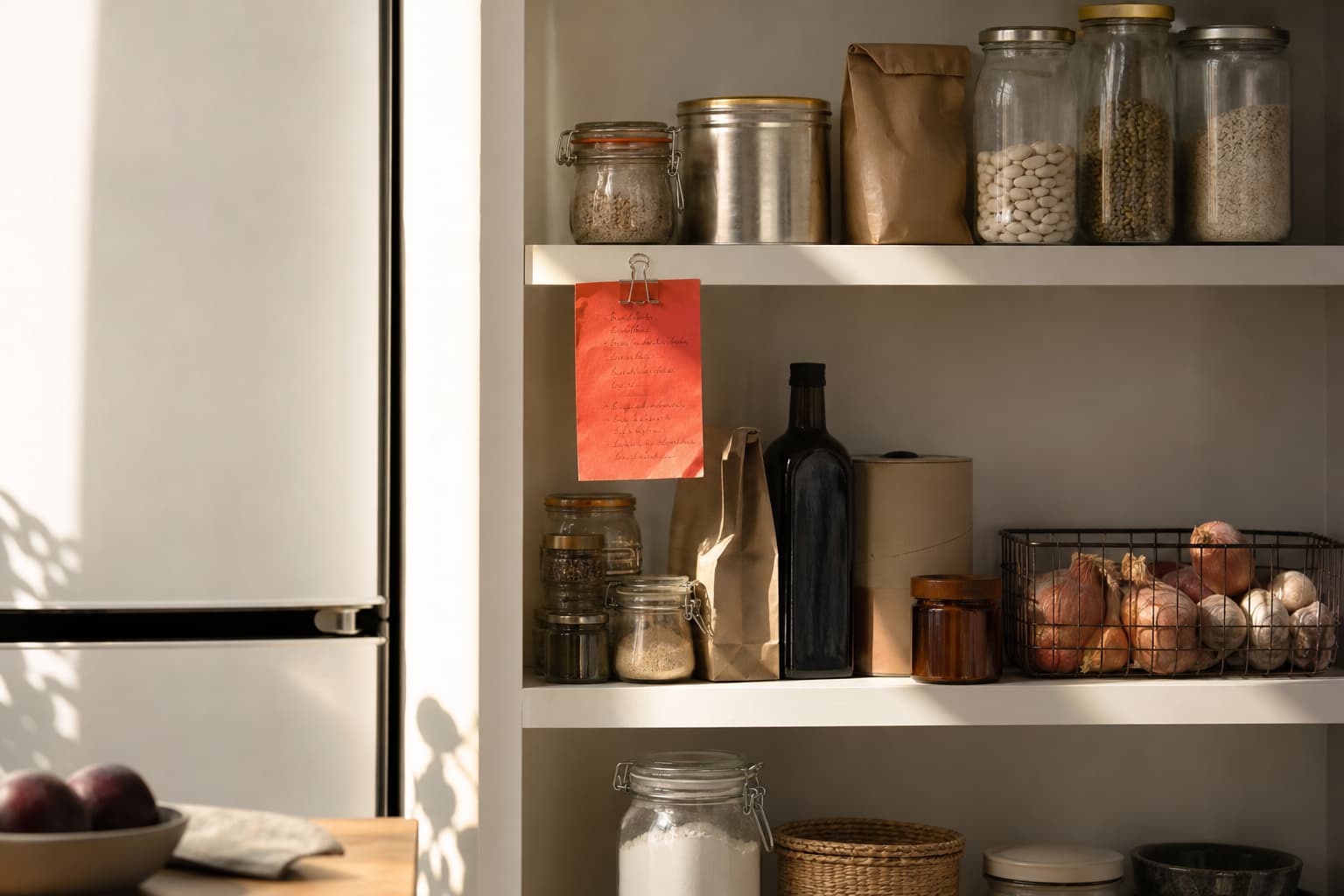
The problem is usually not a character flaw. A kitchen is a set of separate hiding places: produce sits in a drawer, frozen food disappears behind ice, dry goods drift to the back of a cupboard, and leftovers end up behind jars and containers. At 7 p.m., tired, most of us are not answering the question, “What food do I own?” We are answering, “What can I eat with almost no effort?”
A recent discussion in a no-buy community makes that tension visible. People described shopping for an imagined week of energetic home cooking, then ordering food on tired evenings while the groceries went unused. Replies repeatedly suggested looking through the kitchen first and keeping genuinely easy meals on hand. That is a useful discovery signal about everyday friction, not evidence that the experience is universal. (reddit.com)
Planning from inventory changes the first question. Instead of asking, “What sounds good this week?” ask, “What here needs a decision?” The answer may be less glamorous, but it reduces the number of decisions you have to make in the store—and later, when you are hungry.
How do you meal plan from food already in the house?
You do not need to catalogue every can. The purpose is to spot what is open, perishable, duplicated, or likely to be forgotten.
- Clear one small surface. Use a scrap of paper, a note on your phone, or a whiteboard. Make three headings: “use first,” “building blocks,” and “buy.”
- Check the fridge first. Write down food that needs attention in the next few days: opened packages, cooked food, salad leaves, soft vegetables, fruit, and dairy. Ignore condiments unless one is central to a meal.
- Check the freezer and cupboards. Look for building blocks, not a full inventory: bread, grains, pasta, beans, frozen vegetables, proteins, stock, and canned goods.
- Make three to five meal combinations, not elaborate recipes. Vegetables plus eggs can become an omelet. Rice plus frozen vegetables can become fried rice. Beans, tomatoes, and bread can become a quick soup. A combination leaves room for substitutions.
- Look at your actual week. If Tuesday ends with a late meeting, do not assign a 45-minute recipe to Tuesday. Plan leftovers, a freezer portion, a sandwich, or another honest low-effort dinner.
- Write down gaps only. Perhaps you need bread, onions, and yogurt. That is your grocery list. Do not add an appealing item “just in case” unless you can name the meal it belongs to.
- Give leftovers a calendar slot. Wednesday lunch, Friday’s assemble-a-plate dinner, or a freezer session all count. Leftovers with no destination often become a surprise at the back of the fridge.
The EPA specifically recommends making lists around the number of meals people will actually eat at home and including quantities—for example, enough salad greens for two lunches. This is more useful than finding a flawless meal-planning template. (epa.gov)
How much of the week should you plan?
Not every breakfast, lunch, and dinner. A rigid plan can break the moment work runs late, you get invited out, or you simply do not want the meal you assigned yourself. Plan only what lowers friction: which food gets used first, which evenings need easy options, and when leftovers will be eaten.
| Approach | What happens first | Main benefit | Main risk | Best use |
|---|---|---|---|---|
| Recipe-first planning | Choose recipes, then shop for all ingredients | Clear and satisfying | Duplicate ingredients and surplus food | An empty kitchen or a special occasion |
| Inventory-first planning | Check food, then choose meals | Fewer hidden duplicates | Requires a 15–20 minute check | An ordinary week with a stocked kitchen |
| Decide-at-dinnertime | Choose only when hungry | Almost no preparation | More takeout and last-minute buying | Occasional free days, not a default system |
For many households, the useful middle ground is two specific meals, two flexible combinations, and one no-cook or no-pressure evening. The plan becomes a set of options for your real life, rather than a contract with your most organized imaginary self.
This works well alongside a simple three-number budget: your grocery category starts to reflect not just checkout totals, but food already sitting unused at home. It also borrows a basic decluttering principle from how to declutter your home step by step: visibility comes before decisions. A cupboard does not need to look styled. You need to be able to see what deserves attention.
What can you do with leftovers if you do not want the same meal again?
Treat leftovers as ingredients, not as an obligation to repeat last night’s plate. Cooked rice can become fried rice or soup. Roasted vegetables can fill a wrap. Chicken can become a sandwich or salad. But do not turn this into a creativity test. If you dislike a leftover, you do not have to invent a clever transformation for one spoonful.
Give each cooked item one of three paths:
- Eat it again within the next day or two.
- Change its format by adding it to soup, eggs, pasta, a sandwich, or a grain bowl.
- Freeze it in a useful portion if you will not want it soon.
Food safety comes before thrift. U.S. cold-storage guidance generally lists 3–4 days in a refrigerator at or below 40°F / 4°C for many cooked foods, including soups, stews, and cooked meat or poultry; check the specific food when in doubt. (foodsafety.gov) Do not leave perishable food out for long periods, and do not use the freezer to erase a concern about whether food was safely handled.
A clear container, a date, and a lunch-sized portion can be more helpful than a matching set of beautiful storage boxes. If you cannot see the food, you should not be expected to remember it.
Do dates on food labels tell you when food is unsafe?
Not always. In the United States, except for infant formula, many dates on packaged foods are about quality rather than a guaranteed safety deadline. The FDA notes that confusion about date labels contributes to food being discarded early. (fda.gov)
That is not a reason to ignore labels or rely on wishful thinking. If a perishable item smells off, shows mold, has an unusual texture, or may not have been kept at a safe temperature, choose safety over saving it. Label rules and wording differ by country, so local guidance and the manufacturer’s instructions matter more than a universal kitchen slogan.
One practical habit helps: label your own container with the date opened or date cooked. That answers the question you actually face—“When did I make this?”—better than the date printed on an ingredient package.
A no-purchase experiment: five days of “check this shelf first”
Do not attempt a month-long grocery ban. Try a small experiment that costs nothing.
- Choose one cupboard shelf, one refrigerator drawer, or one freezer section.
- Move five to eight foods you want to use toward the front.
- Write down three possible meal combinations that use them.
- For five days, check that zone before you shop, order groceries, or order dinner.
- At the end, record observations rather than savings: What did you happily eat? What was duplicated? What would you not buy again?
This is valuable because it produces evidence about your household. You may discover that you do not need a new organizer or an ambitious meal-prep routine. You may need one reliable Thursday dinner, fewer delicate greens, or a habit of freezing bread on the day you buy it.
When this does not apply
Inventory-first planning should not become a rigid rule when you have medical, dietary, or cultural requirements that call for particular foods; those needs come first. It also cannot solve limited access to fresh food, unstable income, or a kitchen without dependable cold storage.
Do not use “use everything up” as a reason to eat food that may be unsafe, ignore hunger, or avoid hospitality and spontaneity. If the amount of food at home feels overwhelming, start with one drawer and one week. Your kitchen should make eating easier, not turn dinner into another self-improvement project.
How do you keep this from becoming a Sunday chore?
Keep one short “use first” list in plain sight instead of a full household inventory. Update it when you are about to shop, rather than insisting on the same day every week. After cooking, decide where extra food goes immediately: tomorrow’s lunch, the freezer, or someone else’s table.
After a few weeks, you may notice something more useful than a perfectly tidy pantry. You will learn which purchases support your real rhythm and which purchases belong to a fantasy version of it. That is kitchen minimalism: not owning less food at any cost, but owning less food that goes unseen and unused.
Sources
- Preventing Wasted Food at HomeU.S. Environmental Protection Agency
- How to Cut Food Waste and Maintain Food SafetyU.S. Food and Drug Administration
- Cold Food Storage ChartFoodSafety.gov
- A systematic literature review of impactful food waste interventions at the consumer levelSustainable Production and Consumption
- Groceries/food buysReddit, r/nobuy
- Before You Go to Costco, Try This Grocery Strategy FirstKiplinger
Short answers
How do I meal plan when I barely have any food at home?
Choose two or three basic meals and buy only what completes them. Inventory-first planning still helps with an almost empty kitchen because it prevents a cart full of unrelated ideas for later.
Do I need a complete pantry inventory?
No. For most people, a short “use first” list of opened, perishable, and long-forgotten food is enough. Keep a full inventory only if it genuinely makes shopping easier.
How do I meal plan for one person without too many leftovers?
Plan flexible components rather than seven different dinners: one grain, one protein, vegetables, and two ways to combine them. Freeze part of a cooked batch early if you do not enjoy eating the same meal for several days.
What if I still order takeout?
Treat it as information, not failure. Notice when it happens and leave an option for those evenings that is easier than cooking: a freezer portion, soup, a sandwich, or prepared food you actually want to eat.