Short answer
You do not need an app, a giant spreadsheet, or a weekend project to make a useful home inventory. Keep two different records: a short storage map for valuables, seasonal gear, and things that vanish into boxes; and a simple restocking rule for supplies you use up. That makes items easier to find, reduces duplicate buying, and leaves you with basic documentation if you ever need it.
Official preparedness and insurance guidance consistently recommends photos or video, descriptions of important belongings, and make, model, and serial details for significant items. It also advises keeping a copy somewhere other than your home.[1][2][3] The everyday version can be much lighter than a full insurance inventory.
Why make a home inventory if you can see what you own?
A home inventory is not a test of whether you are organized. It is a way to answer three practical questions without relying on memory:
- Where is it? Think travel adapters, spare bulbs, hand-me-downs, holiday decorations, camping gear, or a repair kit.
- Do we already have it? This matters when a household shops quickly, shops separately, or stores extras in several places.
- What did we have? A record can be useful after a theft, fire, leak, or another covered loss. What counts as useful documentation, however, depends on your insurer and policy.
The trap is trying to answer all three questions with one system. Logging every sponge, pasta packet, and dishwasher tablet makes the record expensive to maintain. Using only attractive bins with no map means you still open them one after another to find a cable.
Recent home-organization discussions show this tension clearly. Individual commenters often say that tracking consumables becomes stale quickly, while a photo, location, and short contents note work well for deep storage. That is anecdotal feedback, not population evidence, but it is a useful design warning: the best system is not the most detailed one; it is the one you can keep using.[5][6]
What should you inventory, and what should you leave out?
Put each category into one of three lanes: storage map, restocking zone, or no record needed.
| What you own | Best approach | Record this | Skip this |
|---|---|---|---|
| Seasonal gear, holiday items, camping kit | Storage map | Box name, location, group photo, short contents note | An entry for every small item |
| Tools, electronics, documents, valuables | Storage map plus evidence | Photo, make/model, serial number, receipt or appraisal if available | Trusting memory alone |
| Cleaning supplies, bulbs, paper goods | One visible home plus a restocking trigger | Zone name and a minimum spare | Daily quantity tracking |
| Short-life groceries | Visibility and meal planning | A “use first” spot and dates where useful | Warehouse-style stock control |
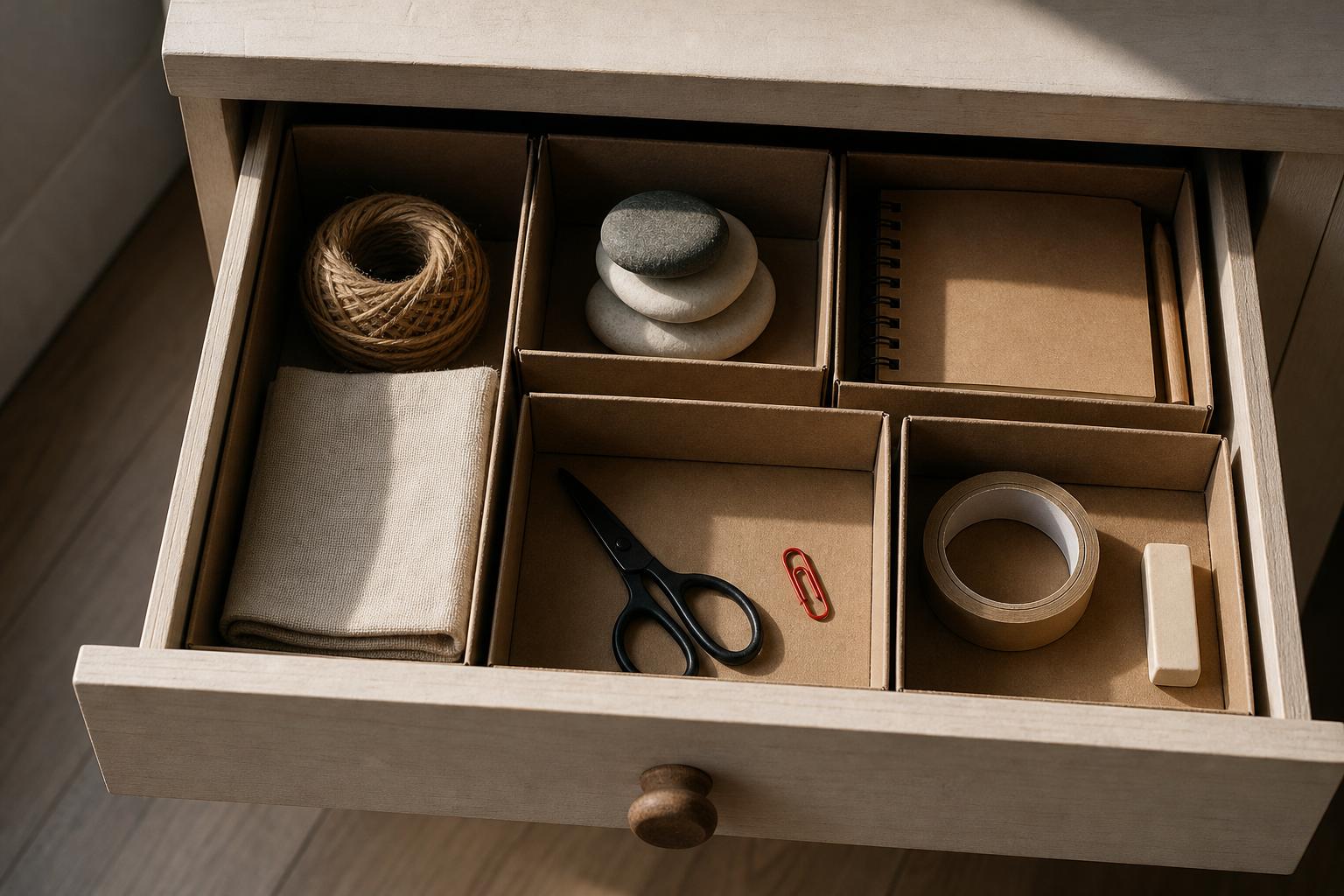
| Everyday items | A consistent home | At most, a drawer or shelf label | Cataloging mugs, scissors, or cutlery |
A storage map is for belongings that leave your visual field for months. A restocking zone is for things that move in and out of the house constantly. This distinction matters far more than whether you use a notebook, a cloud document, or an app.
If groceries are the repeated problem, improve the check-before-you-buy habit before you start cataloging your pantry; see How to Stop Buying Groceries You Already Have. Cables are similar: a reliable shared location is often more helpful than a hundred item records. How to Organize Cables and Chargers Without Chaos can help you create that home first.
How do you make a home inventory in 30 minutes?
Your first pass is not meant to be comprehensive. It is meant to create a small system that still makes sense six months from now.
-
Choose one place for the record. Use one synced note, one cloud document, a paper page in a household folder, or an email to yourself with attached photos. Do not split the system across three tools; that recreates the search problem.
-
Pick four places where things disappear. An attic, closet, garage, basement, under-bed storage, or the top shelf of a utility cupboard are good candidates. Do not start with the entire home.
-
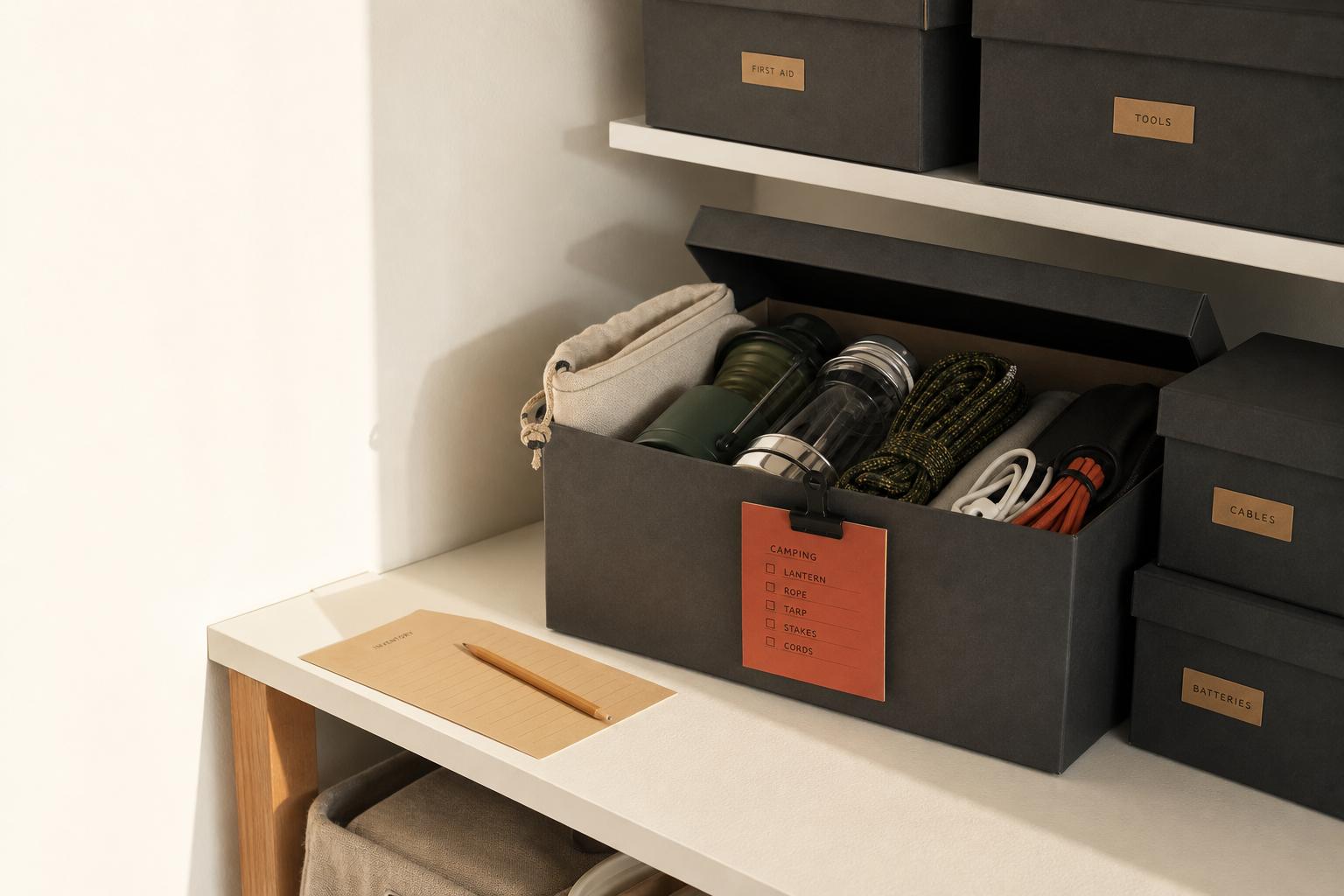
Give containers plain-language names. Use labels such as “Hall closet — top shelf — Box 2,” not “Organizer 17.” If you have many bins, add a large short marker: H2, G3, A1. The label only needs to connect the real box to its record.
-
Take an outside photo and an inside photo. Photograph the box closed, then opened from above. Add a closer shot if the contents are small. Insurance and preparedness guidance also recommends documenting closets, drawers, garages, sheds, and serial numbers on electronics and appliances.[1][3][4]
-
Write one line per container. Use:
location — container — contents — checked date. For example:Garage, G3 — tent, stove, first-aid kit, lanterns — checked November 2026. -
Make a separate entry for important items. For a laptop, camera, musical instrument, expensive tool, jewelry, collection, or artwork, add a photo, make, model, serial number, and receipt or appraisal if you have one. Insurance regulators specifically recommend these details and advise storing a copy away from home.[1][2][3]
-
Add a “check before buying” line. It might say:
Before ordering: check G3, hall closet, and household-backup shelf.This turns an archive into a decision tool. -
Back it up outside the home. Email the document and photos to yourself, place them in secure cloud storage, or share a copy with someone you trust. A single copy on a computer inside the home may be inaccessible precisely when you need it.[2][3][4]
Do not price every teaspoon. State guidance commonly suggests starting with room photos or a walkthrough video, then adding details for the things that matter most. That is also the most humane way to finish the task.[1][4]
How do you track household supplies without updating a list every day?
For supplies, rely on physical visibility, not a detailed record. Give each category one primary home: cleaning backups on one shelf, light bulbs in one drawer, batteries in one container. If the same thing lives in the bathroom, kitchen, utility closet, and garage, you cannot check stock quickly.
Then choose one trigger:
- Last-spare rule: add an item to the shopping list when you open the last unopened one.
- Two-unit rule: replace an item when you open one of two matching units.
Either option is better than exact counting for most homes. It asks you to make one decision at the moment of use, rather than maintain a database after every shopping trip.
For a shared household, agree on the meaning of “backup.” It should mean only what is in the designated backup zone. And do not treat a purchase as household stock until it has been unpacked and put away. This prevents the familiar situation where one person sees an empty bathroom while another remembers a replacement still sitting in a grocery bag.
How can a home inventory stop duplicate purchases?
Do not depend on remembering to consult your list. Add the check to a shopping routine you already have.
- Before placing an online order, open your household note.
- Read the “check before buying” line and inspect the relevant zone.
- If you find the item, do not merely close the tab. Put the item where you will use it, or place it somewhere visible for the next task.
- If you truly need a replacement, give the new one a home before you store it.
This works well alongside a deliberate no-buy boundary. How to Make a No-Buy List Without Rigid Rules can help you identify categories where duplicates repeatedly appear. If the inventory reveals things you no longer want to keep, avoid turning the discovery into an all-day purge; use the smaller starting point in How to Declutter Your Home: a Step-by-Step Plan.
A no-purchase experiment: map one shelf for seven days
Do not buy bins, QR stickers, a scanner, or an app subscription. Choose one shelf or one box that makes you search or rebuy things most often.
- Gather like with like.
- Take two photos: the whole space and its contents.
- Write its location in one line in your chosen note.
- Add a paper label, such as “Closet H1 — travel.”
- For seven days, check that record before making any related purchase.
At the end of the week, ask two questions: Did you find something more quickly? Did maintaining the system feel like a chore? If both answers are favorable, map one more zone. If not, simplify. You may need more visible storage, a clearer permanent home, or fewer duplicates—not a better database.
When is a home inventory for insurance rather than organization?
Organization and insurance documentation overlap, but they are not the same project. For a claim, it helps to understand your coverage, limits, exclusions, and the documentation your specific insurer asks for. The National Association of Insurance Commissioners says an inventory can help you assess personal-property coverage and support a claim; it recommends details including brand, price, purchase date, model, serial number, receipts, and photos.[2]
This is not legal or insurance advice. Policy terms, covered events, and claims processes differ by jurisdiction and contract. If you own high-value jewelry, art, a collection, professional equipment, or specialized tools, ask your insurer whether an appraisal, scheduled coverage, or another step is necessary. Ready.gov likewise advises considering an appraisal for high-value belongings.[3]
When this doesn't apply
Do not build a detailed inventory when it is standing in for a simpler fix. If you are logging dozens of identical consumables every month, consolidate them into one visible backup zone first. If boxes move constantly between homes, family members, or worksites, start with stable locations and readable labels. And if you are documenting belongings after a loss, do not rely on this article alone: contact your insurer promptly and ask what evidence and records it requires.
A good home inventory is not proof that you are disciplined. It answers “where is it?” quickly enough that you do not buy it twice or spend an evening searching for it.
Sources
- Home Inventory GuideCalifornia Department of Insurance
- Understanding Your Homeowners or Renter's PolicyNational Association of Insurance Commissioners
- Are You Ready? An In-Depth Guide to Citizen PreparednessReady.gov
- A home inventory: Why you need it and how to do itTexas Department of Insurance
- We Tested Home Inventory Apps. These Are the Best Ones.NerdWallet
- Inventory TrackerReddit / r/Homeorganization
Short answers
Do I need to list the value of everything I own?
No. For everyday retrieval, a location and photo are usually enough. Prioritize price, receipts, model, and serial information for valuable electronics, tools, jewelry, collections, and other significant belongings.
Is a video or a set of photos better for a home inventory?
Video is fast for an initial room walkthrough. Photos are easier to use for specific valuables, serial numbers, and the contents of drawers or boxes; using both is reasonable.
How often should I update a home inventory?
Update the storage map after a move, major purchase, or meaningful reorganization. For insurance documentation, do a quick annual review and add important purchases as they enter the household.
Where should I store a home inventory safely?
Keep a copy away from home, such as in secure cloud storage, your email, or with a trusted person. Do not broadly share images of passports, keys, account numbers, access codes, or other sensitive material.