Short answer
You can organize your home without buying containers by reducing the volume first, grouping like with like, and assigning the remaining items a clear home. A container is useful when it protects, separates, or makes a stable category easier to use—not when it merely hides an undecided pile. If you cannot say exactly what will go inside it and where it will live, wait before buying it.
This is not a rule against storage products. It is a way to stop spending money on a system before you know what the system needs to hold.
Why does organizing often start with less, not more storage?
The familiar promise is appealing: see a messy space, buy matching bins, and turn disorder into a finished-looking project. Shopping creates momentum. It also skips the questions that determine whether a setup will last: What do you actually use? How many duplicates do you need? What needs to be close at hand on an ordinary weekday?
Consumer Reports recently identified buying organizing products before sorting and decluttering as a common mistake reported by professional organizers. Their practical advice is not that bins are inherently bad; it is that sequence matters. Sort first, then assess what remains, then buy only what the finished category requires. (consumerreports.org) Recent home-organization reporting reaches the same practical conclusion: reducing the amount in a space can reduce the work of storing, cleaning, and remembering it. (theguardian.com)
Think of these as three separate jobs:
| Job | What can work without a purchase | When a container may help |
|---|---|---|
| Finding an item | Put similar things together and give them one home | Small things disappear in a deep drawer |
| Putting an item back | Make its home obvious and leave room around it | A shared space needs a visible boundary |
| Protecting an item | Choose a dry, suitable place | It needs protection from dust, moisture, pests, or transport |
| Making things fit | Reduce duplicates, adjust stock levels, use existing vertical space | The necessary items truly exceed a measured space |
A bin does not create a category. It only draws a border around one. If the label would be “miscellaneous,” “maybe later,” or “I don’t know,” the category needs a decision before it needs a box.
How do you organize your home without buying containers?
Do not attempt this across the whole house in one weekend. Pick a bounded area: one bathroom drawer, one kitchen shelf, the entryway drop zone, a medicine cabinet, or a single desk drawer. A small boundary makes it possible to finish, test, and revise the system.
-
Name the place and the friction.
Skip “organize the kitchen.” Try “find pot lids without moving three piles” or “stop buying another shampoo when one is already open.” A precise problem makes an all-purpose shopping trip less tempting.
-
Take everything out of that one area.
You do not have to empty every closet as a ritual. But emptying one drawer lets you see the real quantity, obvious duplicates, and things that have been living in the wrong place. Keep a trash bag, a donate bag, and a small “belongs elsewhere” pile nearby.
-
Sort by use, not by how items look.
A useful category answers, “When do I reach for this?” Examples: everyday tea, backup tea, active charging cables, cables for retired equipment. “Pretty small things” and “all electronics” sound tidy but do not tell anyone where an item should go back.
-
Remove the easy excess first.
You do not need to make a major life decision about every possession. Start with empty packaging, expired products, broken items, mystery parts with no device, four near-identical spatulas, and samples you do not use. For harder decisions, make a dated “decide later” box and revisit it in 30 days.
-
Give each category one address.
An address can be a shelf, a section of a drawer, a hook, a folder, or a box you already own. It does not have to look polished. It should allow someone in the home to finish this sentence: “The spare batteries are here.” If a category needs two addresses, make the reason clear: daily medication in the bathroom; a travel kit in the suitcase.
-
Put items back according to real use.
Daily items go within easy reach. Rarely used items can go higher, lower, or farther away. Heavy items should not live on a high shelf. This matters more than visual symmetry. Organizing professionals likewise recommend keeping frequently used items accessible and moving less-used items out of prime space. (consumerreports.org)
-
Leave some empty space.
A shelf filled to its limit cannot absorb an ordinary grocery trip, laundry day, or seasonal change. Empty room is not a failure to maximize storage; it is capacity for daily life. A recent Reddit discussion about storage being completely full captures a recurring practical frustration: when every cupboard and bin is packed, even a useful new item can trigger a need for more furniture or more boxes. It is an anecdotal signal, not a universal standard, but it is a useful prompt to notice your own margins. (reddit.com)
-
Only now ask whether a container solves a repeated problem.
Are items getting lost, mixed up, damaged, or in the way of a drawer closing? If yes, measure the space, count the items, and buy one specific solution for one specific job. Do not buy a set “just in case.”
What can you use instead of new organizers?
A temporary solution does not need to be beautiful. It does need to be clean, safe, and proportionate to the task. The aim is to test a category without creating another project.
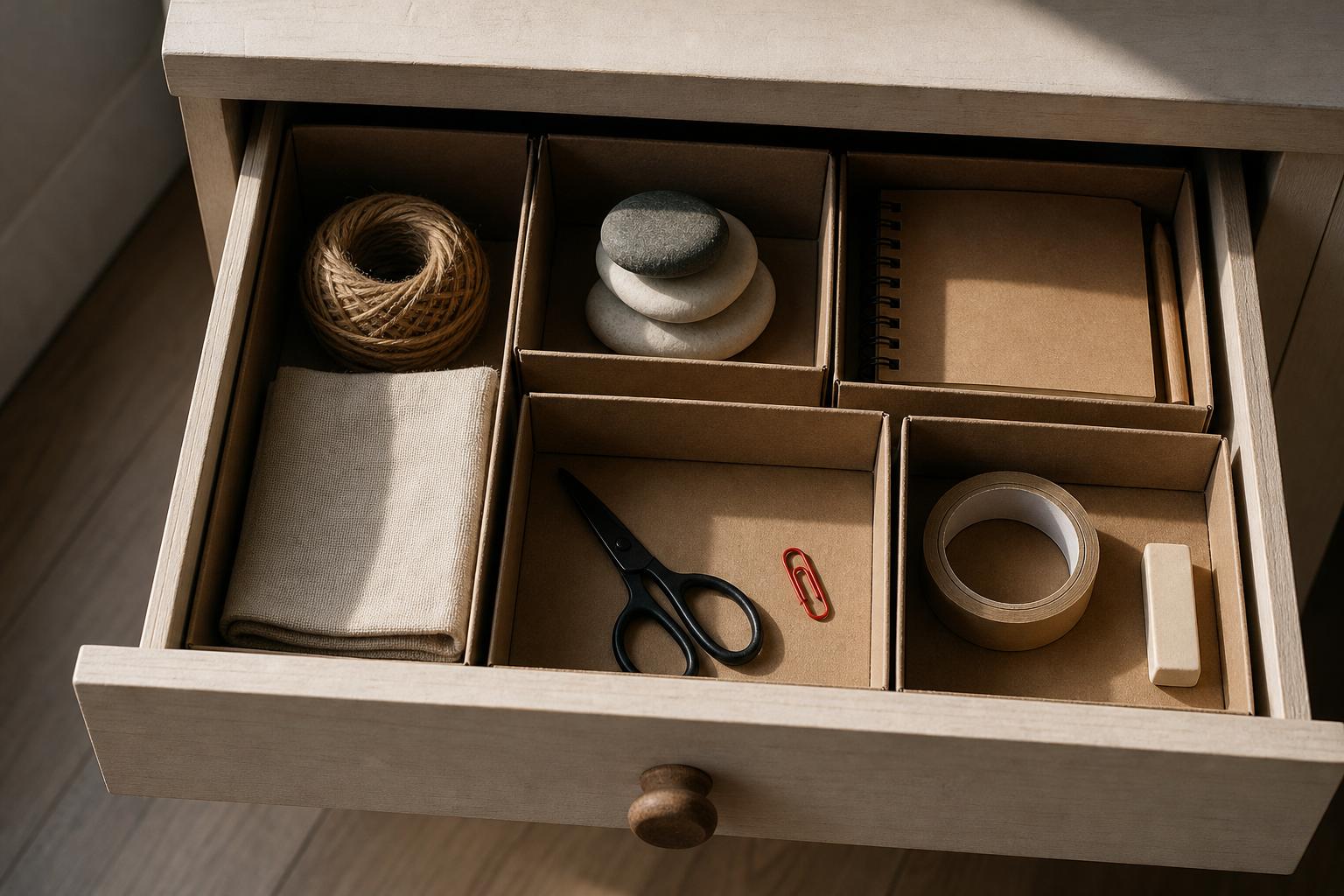
- Shallow delivery boxes can divide stationery, cables, tea bags, or small bathroom items.
- An unused mug or glass can hold pens, brushes, or combs.
- Clean jars with lids can contain small objects that do not require specialist storage.
- A tray or plate can create an intentional landing spot for keys, glasses, or the charger you use every day.
- Existing bags or garment covers can hold seasonal textiles in a dry place.
- Painter’s tape and a marker can label a shelf or box while you test the setup.
There are limits. Do not reuse food packaging for household chemicals. Do not decant medication into unlabelled containers. Do not treat a temporary household solution as a substitute for safe storage around children. Convenience does not outrank product instructions or basic safety.
The U.S. Environmental Protection Agency places source reduction and reuse ahead of managing waste after the fact. In household terms, that supports pausing before a new purchase and using a suitable item you already have. It does not mean keeping every jar or box for a hypothetical future purpose; that simply turns reusable packaging into another category of clutter. (epa.gov)
When should you buy storage containers after all?
A no-buy approach should not become a purity test. A container is worth buying when it solves a recurring, observable problem rather than giving temporary relief from visual mess.
A dedicated solution is reasonable when:
- items can be damaged by moisture, dust, pests, or light;
- small items repeatedly mix together and become hard to use;
- several people share a space and need clear boundaries;
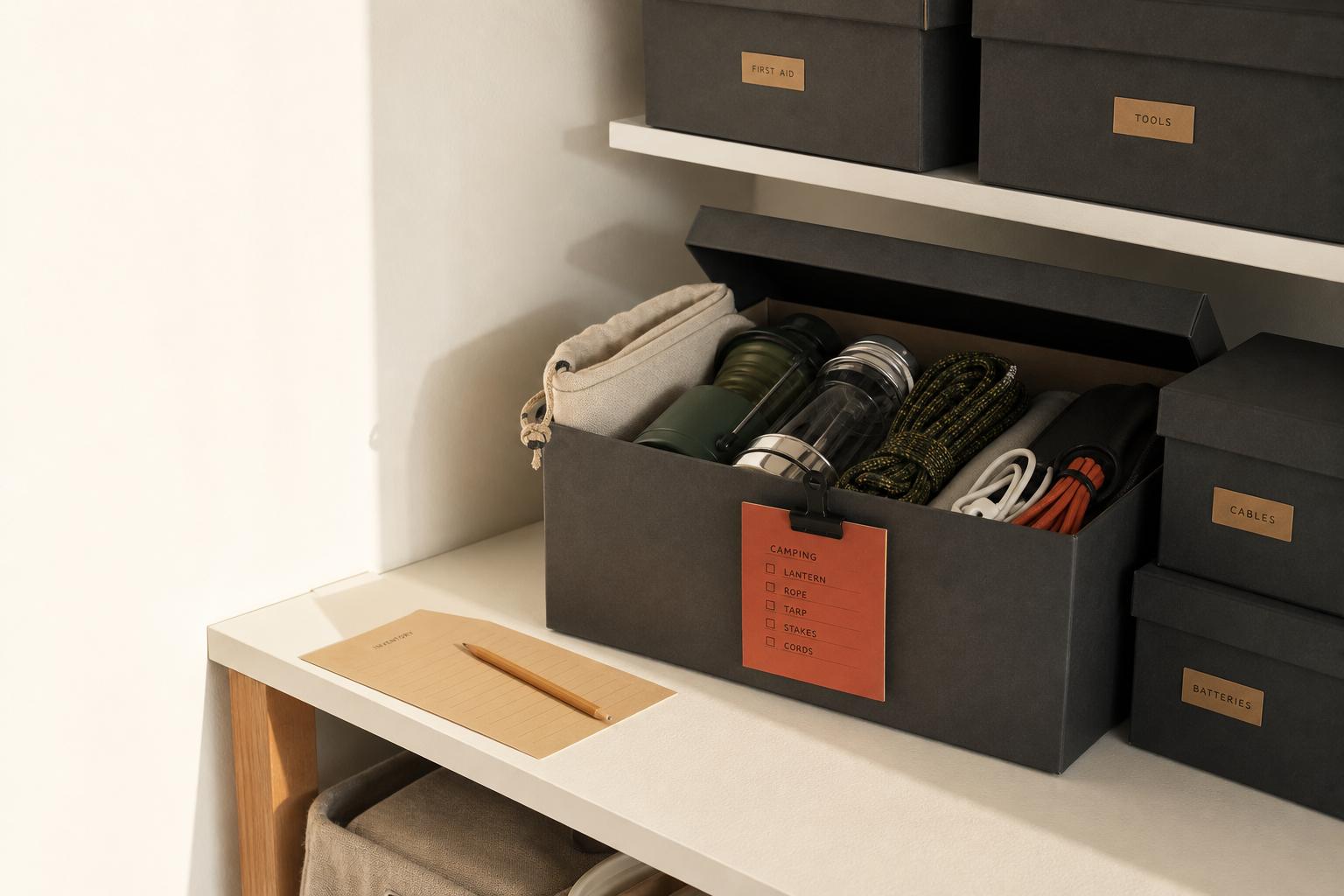
- you are moving, storing seasonal goods, or keeping emergency supplies;
- items need secure, labelled storage for safety;
- a necessary category still will not fit in its assigned, measured space after you have edited it.
At that point, buy a specification rather than an aesthetic: width, depth, height, opening method, contents, and destination. Put the shelf measurements in a note, take a photo, and do not buy a bundle until each piece has a planned location. This goes well with making a home inventory without an app or spreadsheet: see what you have before deciding what you need.
Try this seven-day no-purchase experiment
Choose one drawer, shelf, or cupboard that feels troublesome. For seven days, buy nothing for that area.
- Divide the contents into three to six understandable categories.
- Use only existing boxes, trays, or open sections of the drawer.
- Add temporary labels with painter’s tape.
- Whenever something does not get put back, write down why instead of fixing it with a purchase.
- On day seven, review your notes.
There are three useful outcomes. If items keep mixing, you may need a divider. If the category will not fit, you may need less of it or a container designed for it. If the setup holds, you have saved yourself a purchase. This is an experiment, not a test of whether you are “good” at minimalism. Its purpose is to replace assumptions with evidence from your own home.
If the urge to buy bins is mostly a way to feel that you have started, make the pause visible. A short no-buy list can help without turning into a harsh rule; see how to make a no-buy list without rigid rules.
How do you maintain order without containers?
An inexpensive system lasts because the return path is short, not because it looks perfect. Make the easy thing easy.
First, avoid categories that are too fine-grained. If you live alone and own three pens, you do not need separate compartments for blue, black, and pencils. Second, separate backstock from daily use when stock is hiding what is already open. Third, revisit only places where order has stopped helping: the drawer will not close, you bought a duplicate, or people regularly ask where something is.
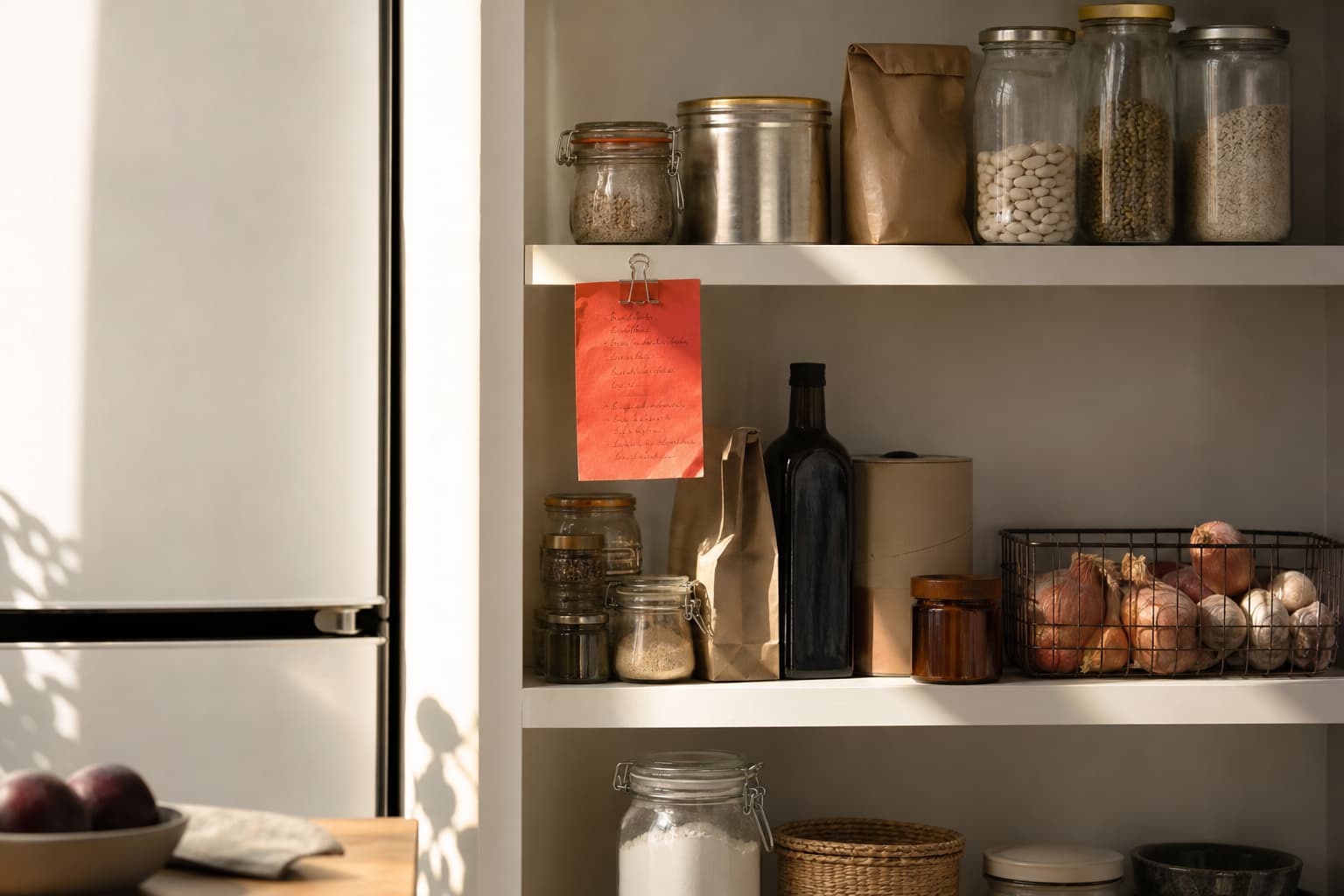
In a kitchen, that may mean one defined backup zone instead of decanting every dry good into matching canisters. In a linen closet, it may mean fewer duplicate towels or sheet sets rather than vacuum bags. At the entryway, it may mean one tray for current items rather than a full furniture system. If the issue is accumulation throughout the home, start with a step-by-step plan to declutter your home instead of trying to contain everything.
When this doesn't apply
This approach does not replace appropriate storage for documents, medication, chemicals, tools, children’s items, or anything that needs protection from dampness or pests. It may also be insufficient during a move, renovation, caregiving period, or a shared-home transition with very different habits. A home with genuinely limited built-in storage can need shelving, sealed bins, or other durable equipment.
In those cases, containers and professional help can be sensible purchases. The useful distinction is simple: define the job and the volume first. Buy for the life you actually live, not for a photo of a shelf.
Organizing without new containers is not about getting by with less at all costs. It is about a more reliable order of operations: see the items, decide their status, give what remains a clear address, and buy only where a tool will truly reduce friction.
Sources
- 5 Home Organizing Mistakes and What to Do InsteadConsumer Reports
- How to Organize a PantryConsumer Reports
- Sustainable Materials Management: Non-Hazardous Materials and Waste Management HierarchyU.S. Environmental Protection Agency
- Declutter, define, discard: seven easy and cheap home organization tips, from expertsThe Guardian
- Your storage should almost never be 100% fullReddit, r/declutter
Short answers
Can I organize my home without buying anything at all?
Often, yes—especially for drawers, shelves, and small categories. Existing boxes, trays, jars, hooks, and clear shelf zones can be enough once you have removed excess and grouped similar items.
Should I declutter before buying storage containers?
Usually, yes. Sorting first shows the real size of each category and may reveal that you already have enough storage; then any purchase can be measured and specific.
What storage containers are worth buying?
Buy containers that solve a defined problem: protecting items, safely containing them, separating small pieces, or fitting a measured space. Avoid assorted sets bought before you know what each piece will hold.
How do I stop buying organizers impulsively?
Try a seven-day no-purchase test with temporary dividers and labels. Keep a note of what actually fails; buy only if the same practical problem repeats.